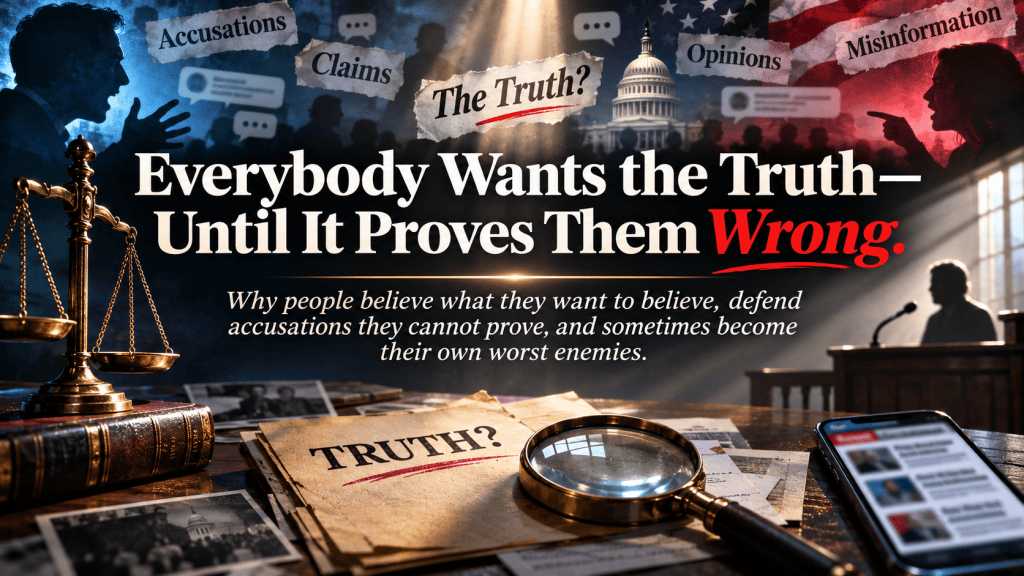
Why people believe what they want to believe, defend accusations they cannot prove, and sometimes become their own worst enemies.
By Joshua L Mullins
There was a time when people were warned not to believe everything they heard.
Today, we have people believing almost everything they hear, provided it comes from somebody they already agree with.
Think about how much information passes through an ordinary American household in a single day. Television news runs in the background. Social media delivers an endless supply of headlines, videos, accusations, and political commentary. Friends share articles. Family members send messages. Somewhere along the way, somebody announces that they’ve finally discovered what’s really happening in Washington.
And before long, people are arguing about information that nobody in the room has actually verified.
It’s an interesting development. We have access to more information than previous generations could have imagined, yet we’ve somehow managed to make independent thinking seem optional.
But here’s the part that concerns me.
What happens when the information we’ve accepted turns out to be false?
Do we reconsider what we believe?
Do we investigate?
Or do we become so determined to defend our position that even the evidence becomes our enemy?
I write from a Christian conservative worldview. I believe truth is objective, that individuals are responsible for their own actions, and that freedom requires both personal responsibility and accountability from those who exercise power.
I also believe something that shouldn’t be particularly controversial.
An accusation is not evidence, and a person’s reputation should not be destroyed simply because somebody has told a convincing story.
Unfortunately, we live in an age when a convincing story can travel considerably farther than the evidence that disproves it.
And sometimes the biggest obstacle to discovering the truth isn’t the person telling the lie.
It’s the person who desperately wants to believe it.
The Problem With Being Absolutely Certain
In 1979, three Stanford University researchers—Charles Lord, Lee Ross, and Mark Lepper—conducted a fascinating experiment involving people who held opposing opinions about capital punishment.
The participants examined studies that appeared to support or challenge their existing positions.
You might expect that exposing people to conflicting evidence would encourage them to reconsider what they believed.
Instead, participants tended to regard information supporting their existing beliefs as more convincing, while questioning the quality of information that challenged them.
Both groups became more confident in their original positions.
Think about that.
People examined conflicting information and walked away more convinced that they had been right all along.
The researchers published their findings in the Journal of Personality and Social Psychology. The experiment was relatively small, involving 48 undergraduates, so it shouldn’t be treated as proof that everyone always responds this way. But it demonstrated an important possibility: people can evaluate evidence differently depending on what they already believe.
Psychologists describe this tendency as confirmation bias.
And if you’ve ever watched two people argue about politics, you’ve probably seen something that resembles it.
One person presents a source.
The other dismisses it.
A second source appears.
That one’s apparently unreliable too.
Then someone produces a Facebook post agreeing with the original accusation.
Suddenly, we’ve discovered the gold standard of investigative journalism.
Apparently, evidence is only questionable when it disagrees with us.
But this isn’t merely an amusing feature of political arguments.
It can have serious consequences.
Because the moment we decide that our beliefs must be protected from examination, we stop asking whether something is true and start asking whether it is useful.
And those are two entirely different questions.
Three Men, One Accusation, and a Nation That Rushed to Judgment
In March 2006, a criminal accusation involving members of Duke University’s men’s lacrosse team became national news.
A woman named Crystal Mangum accused several players of sexually assaulting her at a party in Durham, North Carolina.
Three players—David Evans, Collin Finnerty, and Reade Seligmann—were eventually charged.
The allegations were extremely serious. They involved accusations of sexual violence, and the case quickly became entangled in public arguments about race, wealth, privilege, and justice.
National news organizations reported extensively on the story.
People formed opinions.
The accused became the subjects of enormous public scrutiny.
The case seemed to present everything necessary for a national controversy.
There was only one problem.
The evidence didn’t support the accusation.
As the investigation progressed, serious inconsistencies emerged. The identification procedures were unreliable. DNA evidence did not support the allegation, and investigators could not find independent evidence corroborating the alleged assault.
Yet the prosecution continued.
On April 11, 2007, North Carolina Attorney General Roy Cooper announced that all remaining charges were being dismissed.
He went further than simply saying prosecutors couldn’t prove the case.
He declared that the three men were innocent.
Cooper described the prosecution as the result of a rush to accuse and a failure to verify serious allegations.
The district attorney who pursued the case, Mike Nifong, was subsequently disbarred for professional misconduct.
But the story didn’t end there.
In December 2024, almost eighteen years after the original accusations, Mangum publicly admitted that she had fabricated them.
She acknowledged that she had falsely accused the men of rape.
Consider the consequences.
Three men had faced criminal charges, public condemnation, and enormous damage to their lives.
The university’s lacrosse season had been canceled. Families endured years of controversy. The case became a national symbol in arguments about race and privilege.
And the central allegation was false.
Now, sexual assault allegations deserve serious investigation, and genuine victims deserve protection and justice. That obligation doesn’t disappear because one accusation was fabricated.
But neither does the presumption of innocence disappear because an accusation is emotionally powerful.
The purpose of an investigation is to establish what happened—not to confirm what the public has already decided it wants to believe.
Imagine you’re one of those three young men.
Imagine being accused of a terrible crime you didn’t commit.
Imagine your family watching strangers condemn you on national television.
And imagine somebody telling you that your innocence doesn’t matter because the accusation supports a larger political or cultural argument.
Would you accept that?
Or would you demand that somebody finally examine the evidence?
The answer seems obvious when you’re the person standing trial.
Unfortunately, it becomes considerably less obvious when the accused is somebody we dislike.
When Disliking Someone Becomes a Substitute for Proof
Consider what happened after the assassination of conservative commentator Charlie Kirk in September 2025.
A video circulated online accusing Kirk of using a racial slur against an Asian woman.
It was an inflammatory accusation, and the accompanying recording appeared convincing to people who accepted the description.
But FactCheck.org examined the footage.
The recording actually showed Kirk addressing progressive commentator Cenk Uygur by his first name during a 2018 debate.
The accusation was false.
According to FactCheck.org, the inaccurate post attracted more than sixteen million views in less than two days.
Sixteen million people potentially encountered an accusation that the recording didn’t support.
Now, people were entitled to criticize Kirk’s political positions. They could question his arguments, disagree with his Christian convictions, and examine statements he actually made.
But an accusation doesn’t become true because the person being accused is controversial.
And this raises an uncomfortable question.
If you already believe somebody is a terrible person, how much evidence do you require before accepting another terrible accusation against them?
Would you apply the same standard if the accusation concerned your spouse?
Your child?
Your pastor?
A politician you admire?
Or would you suddenly become remarkably interested in due process?
This is one of the dangers of allowing political loyalty to replace independent judgment.
We can become so convinced that our opponents are wrong about everything that we’re willing to believe almost anything about them.
And when the facts contradict the accusation, we act as though the facts themselves have betrayed us.
That’s not conviction.
That’s intellectual dishonesty.
And if we’re serious about truth, we have to be willing to recognize it even when it protects somebody whose views we strongly oppose.
What We Don’t Know Can Be Just as Important as What We Do
In October 2024, researchers published another interesting study in PLOS ONE.
It involved 1,261 participants responding to a hypothetical situation.
Some participants received the complete information necessary to consider the problem. Others received only part of the information.
The researchers found that people given incomplete information often believed they had enough facts to make a thoughtful decision.
They weren’t necessarily aware that important details were missing.
The researchers called this the illusion of information adequacy.
In simpler terms, people can feel well-informed without realizing how much they don’t know.
That should concern anyone who regularly consumes political news.
Suppose a commentator tells you that Congress approved a controversial piece of legislation.
You hear a description of what the law supposedly does.
You become angry.
You share the story.
But have you read the legislation?
Do you know whether it actually passed both chambers?
Do you know whether it was amended?
Could the headline be describing a proposal that never became law?
These aren’t unreasonable questions.
They’re the kinds of questions responsible people ought to ask.
Yet we’ve somehow developed a culture in which questioning an allegation is sometimes treated as defending whatever the allegation describes.
Imagine applying that logic in court.
“Your Honor, I would like to examine the evidence.”
“Objection! The defense attorney is clearly sympathetic to the crime!”
Well, that ought to make the trial considerably shorter.
Unfortunately, it would also make justice nearly impossible.
The responsibility to examine evidence doesn’t mean every person must become a professional investigator.
It means we should understand the difference between knowing something happened and merely having heard somebody say it happened.
And there’s nothing disgraceful about acknowledging that we don’t have enough information yet.
Sometimes those are the most intellectually honest words in the conversation.
Scripture Has Something to Say About This
As a Christian, I find it fascinating that the Bible addressed these problems long before television networks, political parties, and social media existed.
Proverbs 18:13 says:
“He that answereth a matter before he heareth it, it is folly and shame unto him.”
That’s remarkably direct.
If you reach a conclusion before examining the matter, Scripture calls that foolishness.
Now consider Proverbs 18:17:
“He that is first in his own cause seemeth just; but his neighbour cometh and searcheth him.”
There is the principle behind cross-examination.
The first person tells a convincing story.
Then somebody examines the account.
Questions are asked. Witnesses are considered. Additional information emerges.
And what initially appeared certain may begin to look very different.
In Deuteronomy 19:15–19, the law of ancient Israel required careful examination when serious accusations were made. The passage addresses witnesses and the danger of deliberately false testimony.
God didn’t establish a standard in which the loudest accusation automatically became the truth.
Nor did He excuse false witness because the person making the allegation believed the accusation served a worthy cause.
But there’s another biblical example I believe deserves our attention.
In Acts 17:11, the Bereans were commended because they received the message being preached with readiness and searched the Scriptures daily to examine whether those things were true.
They were willing to listen.
And they were willing to examine.
Those are not contradictory attitudes.
In fact, they belong together.
Christians shouldn’t be afraid of examining evidence. Our faith in Jesus Christ is not an obligation to believe every political commentator who claims to represent Christian values.
We can hold firm convictions while remaining careful about factual claims.
You can be unshakable in your principles without being unwilling to examine your assumptions.
And we should never forget the commandment in Exodus 20:16:
“Thou shalt not bear false witness against thy neighbour.”
Notice that Scripture doesn’t say we should avoid bearing false witness only when the accused person shares our political beliefs.
Truth isn’t a partisan possession.
It’s a moral responsibility.
The Most Difficult Witness to Cross-Examine
We’ve spent considerable time discussing accusations, evidence, psychology, and the consequences of reaching conclusions too quickly.
But there’s one witness we haven’t examined.
Ourselves.
Because it’s easy to recognize the dishonesty of somebody who disagrees with us.
It’s considerably harder to recognize when we’re doing something similar.
We tell ourselves we’re informed because we follow the news.
But how much of what we believe have we personally examined?
We say we’re interested in facts.
But are we equally interested when those facts challenge our preferred conclusions?
We demand accountability from politicians.
But are we willing to acknowledge our own mistakes?
And when we discover that we’ve shared something false, what happens next?
Do we correct it?
Or do we quietly move on, hoping nobody remembers?
I don’t believe Americans have to agree on every political issue to live together peacefully.
We can disagree about immigration, taxes, foreign policy, religious liberty, and the proper role of government without treating one another as enemies.
But we cannot maintain a healthy society if every disagreement becomes a contest in which truth is sacrificed for victory.
And we certainly cannot expect accountability from our leaders while refusing to practice it ourselves.
I believe the Christian conservative principles of personal responsibility, liberty, and accountability have something important to contribute to this conversation.
But those principles must begin with the individual.
They begin when we refuse to condemn somebody without evidence.
They begin when we examine the information being presented to us.
They begin when we admit that a claim we believed turned out to be wrong.
And they begin when we stop treating people who disagree with us as though they have forfeited their right to fairness.
So before you share the next outrageous accusation, ask yourself a question.
Would I believe this just as quickly if it were being said about somebody I love?
If the answer is no, perhaps it’s time to examine more than the accusation.
Perhaps it’s time to examine the standard we’re using to judge it.
Because the truth isn’t supposed to serve our political positions.
Our political positions ought to be accountable to the truth.
And when the evidence finally arrives, we have a decision to make.
We can examine it, even when the result makes us uncomfortable.
Or we can protect what we’ve already decided to believe.
Everybody says they want the truth.
The real test comes when the truth proves them wrong.
Research and source documentation
- Lord, Ross, and Lepper (1979). Biased Assimilation and Attitude Polarization: The Effects of Prior Theories on Subsequently Considered Evidence. Journal of Personality and Social Psychology, 37(11), 2098–2109.
- Duke University (2007). Duke Lacrosse Incident: University Record and Case History. Includes Attorney General Roy Cooper’s announcement of the players’ innocence.
- Associated Press (December 13, 2024). Woman Who Falsely Accused Duke Lacrosse Players of Rape Publicly Admits She Lied.
- FactCheck.org (September 12, 2025). Viral Claims About Charlie Kirk’s Words.
- Gehlbach, Robinson, and Fletcher (2024). The Illusion of Information Adequacy. PLOS ONE, 19(10).
- Biblical references: Proverbs 18:13, 18:17; Deuteronomy 19:15–19; Acts 17:11; Exodus 20:16. All Scripture quotations are from the King James Version.


Leave a Reply