James Madison’s Warning About Power Is Just as Important Today
By Joshua L Mullins
What happens when the people we trust with power begin to believe the rules no longer apply to them?
It is a question every generation must face. And more than 230 years ago, one of America’s Founding Fathers gave us a remarkably clear answer: Never build a government that depends on the assumption that the people running it will always do the right thing.
James Madison understood human nature. He knew that people could be intelligent, ambitious, patriotic, and well-intentioned—and still make decisions that threatened the freedom of others.
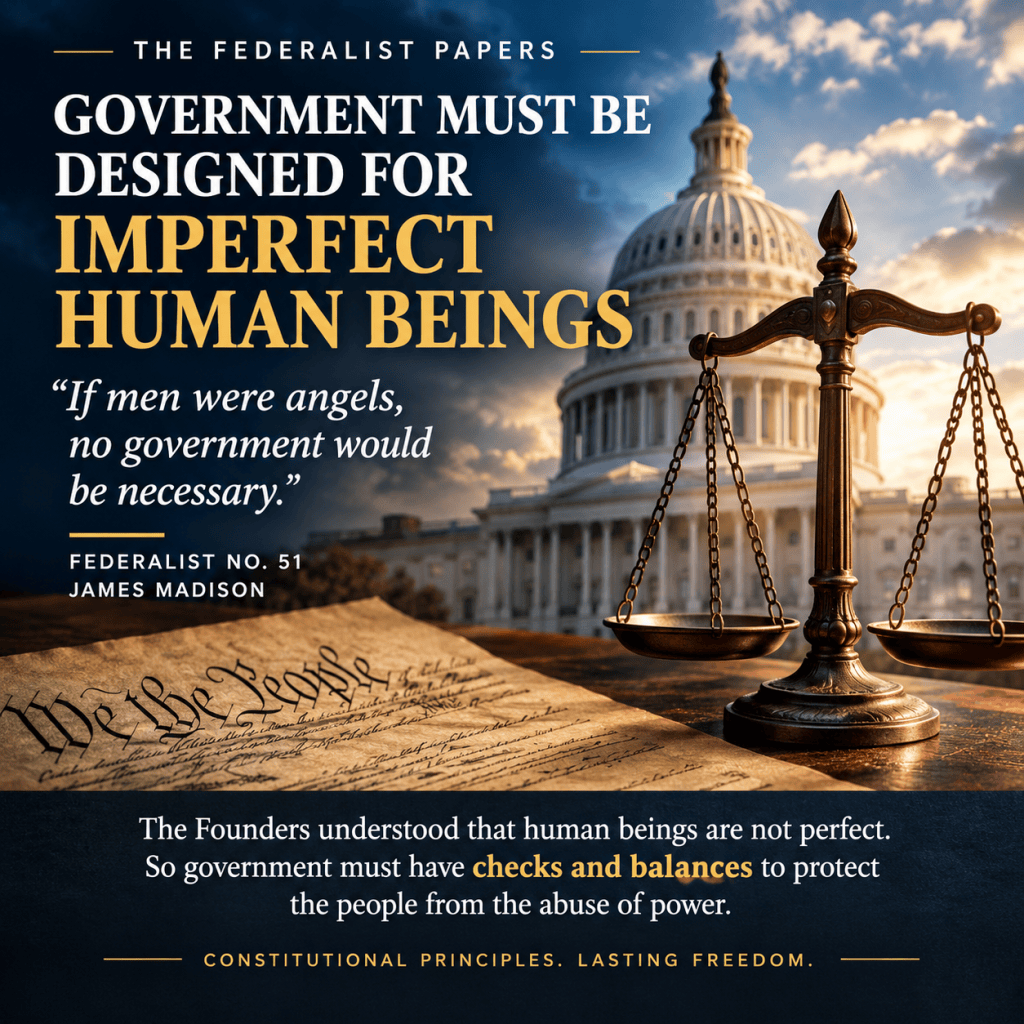
That is why, in Federalist No. 51, published in 1788, he wrote one of the most memorable lines in American political history:
“If men were angels, no government would be necessary.”
Read that again.
Madison was not saying that all people are bad. He was making a much more important point: No human being is so perfect, and no politician is so trustworthy, that we should give them unlimited power.
That belief helped shape the system of government Americans live under today.
And it raises a question we should never stop asking:
Are we protecting the Constitution from those who seek power, or are we simply trusting those who already have it?
THE FOUNDERS KNEW POWER COULD BE DANGEROUS
When America declared its independence, it rejected the idea that a king should possess unchecked authority over the people. The Revolution was fought in the name of liberty, self-government, and the principle that political power must have legitimate limits.
But winning independence was only the beginning.
The new nation still had to answer a difficult question: How could Americans establish a government strong enough to govern effectively without creating another system in which power could be abused?
The Articles of Confederation had left the national government too weak to address many important national problems. In 1787, delegates met in Philadelphia to develop a new constitutional framework.
The result was the Constitution.
Its supporters—including James Madison, Alexander Hamilton, and John Jay—then wrote a series of essays known as The Federalist Papers to explain why the proposed system deserved public support.
Madison’s contribution, Federalist No. 51, addressed a central challenge: How do you give government enough power to do its job while preventing that power from threatening the people it is supposed to serve?
His answer was brilliant in its simplicity.
Do not depend on perfect leaders. Build a system that can restrain imperfect ones.
Think about the wisdom of that principle.
A politician may promise reform. A president may promise to defend freedom. A member of Congress may promise to represent the people honestly. Those promises matter—but promises alone are not safeguards.
What happens when promises are broken?
What happens when ambition takes priority over responsibility?
What happens when an elected official begins treating criticism as disloyalty or opposition as a threat?
The Constitution was designed to ensure that the answer would not simply be, “We have to hope the next election fixes everything.”
It established a structure intended to restrain abuses of power while allowing government to function.
That is the difference between trusting a leader and protecting a republic.
CHECKS AND BALANCES: WHY NO ONE SHOULD HAVE THE FINAL SAY ON EVERYTHING
Madison understood that dividing government into separate branches was not enough by itself. Those branches also needed the means to defend their constitutional responsibilities.
He put it this way:
“Ambition must be made to counteract ambition.”
In plain English, the system should be designed so that one branch has reasons and means to resist another branch when necessary.
Congress makes federal laws. The president executes and administers those laws. The federal judiciary decides cases and controversies under the law, including disputes involving the Constitution.
Their responsibilities overlap in carefully defined ways, giving each branch certain checks on the others.
The president can veto a bill passed by Congress. Congress can override that veto with a two-thirds vote in each chamber. The Senate participates in confirming many presidential appointments. Federal courts can determine that government actions are unconstitutional in cases properly before them.
These arrangements may sometimes appear frustrating. They can slow down government. They can produce disagreements, delays, and political conflict.
But consider the alternative.
Imagine a system in which the same person could write the laws, enforce them, decide whether they had been violated, and punish anyone who disagreed.
Would you feel secure knowing that person was in charge?
Perhaps you would if you trusted that individual completely.
But what if the next person was dishonest? What if the next administration used those powers against people who disagreed with it? What if the person you supported today became tomorrow’s threat to your own rights?
That is precisely why constitutional safeguards matter.
The Constitution should protect Americans from abuses of power even when the person exercising that power is someone they voted for.
Checks and balances are not merely obstacles to getting things done. They are safeguards against concentrating too much authority in too few hands.
YOUR SIDE MAY WIN AN ELECTION. IT DOES NOT WIN UNLIMITED POWER.
Here is where Madison’s argument challenges every American, regardless of political affiliation.
It is easy to demand accountability when the opposing party holds office. It is easy to criticize executive overreach when we dislike the president. It is easy to defend constitutional limits when those limits stand in the way of policies we oppose.
The real test comes when the situation is reversed.
Will we demand accountability when our preferred candidate is in power?
Will we defend the Constitution when doing so is politically inconvenient?
Will we accept legitimate oversight when it challenges a leader we admire?
Or will we suddenly discover reasons why the rules should not apply this time?
These questions strike at the heart of Madison’s argument.
If we believe in constitutional limits only when they hurt our political opponents, we do not truly believe in constitutional limits. We believe in winning.
Winning elections is important. Elections are a fundamental part of representative government. Citizens should be free to support their preferred candidates and advocate for the policies they believe will improve the country.
But an election is not a blank check.
A president has the authority granted by the Constitution and federal law—not unlimited authority simply because millions of people voted for that person.
Congress has constitutional responsibilities that do not disappear because its members belong to the president’s party.
Courts must decide cases according to the law, not political loyalty.
And citizens should expect the same basic standards from every administration.
The question should never be merely, “Is my side winning?”
It should also be, “Is our constitutional system functioning as it was intended?”
Because political power changes hands. The Constitution remains.
THE MAJORITY CAN BE WRONG, TOO
There is another lesson in Madison’s work that deserves serious attention.
Democracy allows citizens to participate in choosing their leaders. But does winning a majority mean that anything the majority wants becomes acceptable?
Of course not.
Madison explored this danger in Federalist No. 10, where he examined the problem of factions—groups united by interests or passions that might threaten the rights of others.
A majority can make legitimate political decisions. But majority support alone does not erase constitutional restrictions or make every action just.
Imagine a majority deciding that a smaller group should lose its freedom of speech because its opinions are unpopular.
Would that decision become acceptable simply because more people supported it?
If constitutional rights depended entirely on popularity, they would offer little protection precisely when protection was most needed.
This is why the Constitution matters. It establishes a framework for government that includes limits on what public officials may do, even when a particular policy enjoys substantial political support.
The rights of Americans should not depend entirely on whether they belong to the most popular group at a particular moment in history.
Liberty means more than having the freedom to agree with the majority. It also means having rights the majority cannot simply vote away.
That principle is not a gift from one political party to another. It is a foundation of constitutional government.
THE PEOPLE MUST HOLD THEIR LEADERS ACCOUNTABLE
Madison did not believe that the structure of government alone could preserve liberty.
In Federalist No. 51, he wrote:
“A dependence on the people, is, no doubt, the primary control on the government.”
He recognized the importance of public accountability while also explaining why additional safeguards were necessary.
That places a responsibility on us.
The Constitution cannot defend itself if citizens do not understand it, pay attention to government, or care whether officials respect its limits.
Voting matters, but citizenship involves more than casting a ballot every few years.
It means asking questions.
It means examining evidence rather than automatically accepting whatever our preferred political voices tell us.
It means understanding the difference between a politician’s promise and the actual authority of the office.
It means being willing to criticize our own side when criticism is warranted.
And it means remembering that disagreement is not treason, political opposition is not automatically corruption, and criticism of an elected official is not the same as opposition to America.
A healthy republic needs citizens who are willing to think independently.
It needs people who care more about the truth than about winning an argument.
Most importantly, it needs people who understand that constitutional principles are worth defending even when doing so comes at a political cost.
WHAT DOES MADISON’S WARNING MEAN FOR US TODAY?
Madison’s words do not automatically answer every modern political or constitutional dispute. Specific questions require careful examination of the Constitution, applicable laws, judicial decisions, and the facts of each situation.
But the principle behind his argument remains powerful.
Government must have the authority necessary to carry out its lawful responsibilities. At the same time, that authority must remain subject to constitutional limits.
We need effective leadership, but we must also have accountability.
We need laws, but those laws must be administered within the Constitution.
We need elected representatives, but those representatives must respect the responsibilities of their offices.
And we need a judiciary capable of deciding cases independently, according to the law.
None of this requires us to agree on every political issue. Americans will continue to disagree about taxes, spending, immigration, public safety, education, foreign policy, and countless other matters.
That is part of living in a free society.
The more important question is whether we can disagree while still respecting the constitutional rules that allow our political system to function.
Can we insist that our leaders obey the law even when we like their policies?
Can we defend the rights of people whose opinions we dislike?
Can we accept constitutional limits even when those limits prevent our preferred outcome?
Those are not just questions for presidents, lawmakers, and judges.
They are questions for all of us.
THE LESSON WE MUST NEVER FORGET
More than two centuries ago, James Madison understood that the survival of a free republic could not depend on the hope that every person entrusted with power would remain honest, humble, and fair.
People are imperfect. Ambitions conflict. Interests compete. And power, when left without meaningful restraints, can become dangerous.
That is why the Founders divided authority and established checks and balances.
They did not create a perfect system that would eliminate every injustice or prevent every mistake. They created a constitutional framework intended to limit government power, protect liberty, and make public officials accountable.
That framework requires our attention and our defense.
Not just when our opponents hold office.
Not just when a court issues a ruling we dislike.
Not just when Congress investigates someone from the other party.
Every time power is exercised, the constitutional standard must remain the same.
Because the purpose of the Constitution is not to guarantee that our favorite politicians always get their way. It is to establish the rules under which all of our leaders must operate.
And the purpose of checks and balances is not to protect one party from another.
It is to protect the American people from the dangers of concentrated and unchecked power.
So the next time a politician asks for more authority, the next time an elected official dismisses criticism, or the next time your own political side tells you that the rules should be different this time, remember Madison’s warning.
“If men were angels, no government would be necessary.”
We should hope for good leaders. We should work to elect honest ones. We should expect them to serve with integrity.
But we should never make the mistake of believing that good intentions eliminate the need for constitutional safeguards.
A free nation cannot survive on trust alone. It needs principles, limits, accountability, and citizens willing to defend them.
And perhaps the most important question of all is this:
Are we defending the Constitution—or are we simply defending whoever happens to be in power?
Read the original: Federalist No. 51 — James Madison


Leave a Reply