By Joshua L Mullins
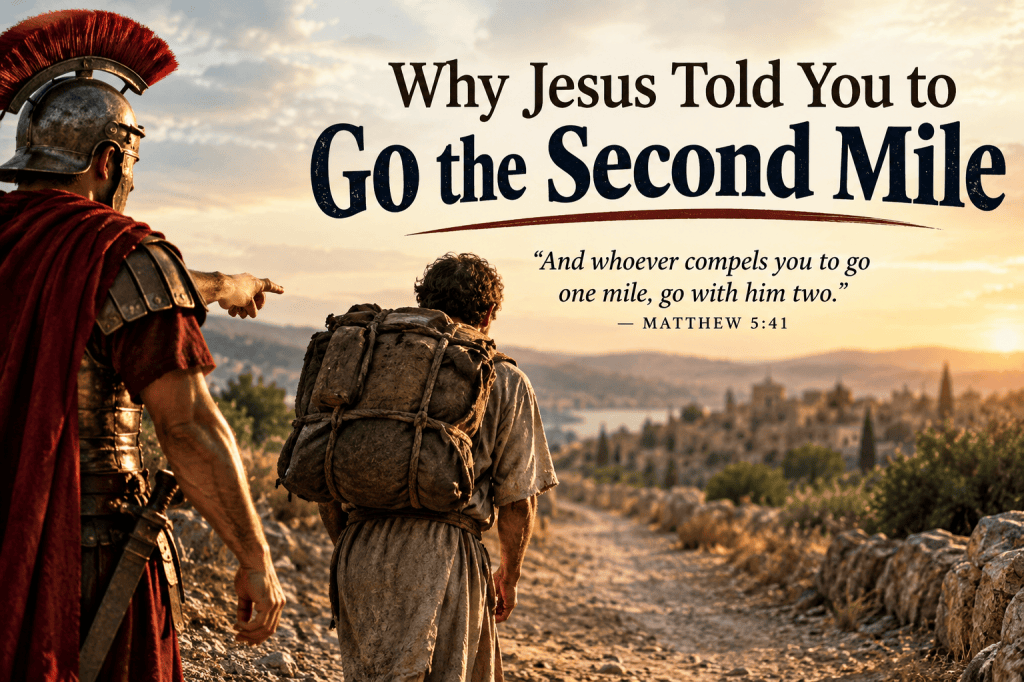
“And whoever compels you to go one mile, go with him two.”
—Matthew 5:41
Imagine you are walking along a dusty road in first-century Galilee or Judea when a Roman soldier suddenly stops you. Without asking permission, he points to the heavy military pack on his back or the equipment he is carrying and orders you to take it. Under Roman law he has the right to do this. You have no choice. You must carry his gear for exactly one Roman mile—roughly 1,480 meters, a little shorter than our modern mile—and then you are free to drop it and walk away. That single mile was the legal limit. Anything beyond it was considered abuse of power.
This practice of forced labor was deeply hated by the Jewish people. The word Jesus used for “compel” or “force” originally came from the Persian Empire. Persian kings maintained a relay system of mounted couriers who carried royal messages across the empire. These couriers had the authority to press any civilian, horse, or cart into service so the mail would keep moving without delay. The Romans adopted the same system. In the occupied provinces they called it angaria. A soldier could legally requisition a local person to carry his baggage for one mile. The Jews resented it so much that a common proverb said the practice was “like death.” It was a constant, humiliating reminder that they were a conquered people.
Jesus knew exactly how His hearers felt about this. He chose one of the most despised everyday experiences of life under Roman occupation and turned it into a teaching about the Kingdom of God. He did not say, “Resist the soldier.” He did not say, “Argue about your rights.” He said, when you are forced to go one mile, go two.
The first mile is obligation. It is the bare minimum required by law or by the person who has power over you. You can fulfill it with clenched teeth, a resentful heart, and a careful count of every step until you reach the marker and can legally walk away. The second mile is different. No one can force you to take it. It is voluntary. It is an act of free choice. When you deliberately carry the load beyond what is demanded, you stop being a victim of coercion and become someone who is serving by choice. You deprive the one who compelled you of the satisfaction of controlling you. You transform a humiliating demand into an opportunity to demonstrate a completely different spirit.
This is not passive resignation. Jesus was not telling His followers to become doormats who simply absorb every injustice without response. He was showing them a way to respond that refuses to play by the rules of the oppressor. The natural reaction is resentment, anger, or the desire to get even. The Kingdom response is an excess of goodness that the other person does not expect and cannot control. It is the deliberate choice to measure your actions by love rather than by the letter of the requirement.
The same principle still operates today. You may not have a Roman soldier stopping you on the road, but you face situations in which someone has the power or the right to demand a certain amount of your time, effort, or service. It might be a demanding boss, an unfair workload, a difficult family member, a customer who feels entitled, or any obligation that feels forced. The first mile is doing what is required—showing up, fulfilling the duty, meeting the expectation. The second mile is the extra that no one can demand: the cheerful attitude, the additional help, the willingness to stay a little longer, the genuine concern that goes beyond the job description or the minimum requirement.
When you walk that second mile, something powerful happens. The atmosphere changes. The person who compelled you no longer holds the same power over your spirit. You have moved from forced compliance to willing service, and that shift is noticeable. It is also the kind of response that the Holy Spirit empowers. You do not manufacture this attitude by sheer willpower. As you yield to the Spirit, He produces in you the ability to respond with grace instead of resentment, with generosity instead of the bare minimum.
Jesus Himself lived this way. When soldiers compelled Simon of Cyrene to carry the cross, the scene was a living picture of the very thing Jesus had taught. The Lord who told His followers to go the second mile walked the path of willing surrender all the way to the end. He did not resist the injustice with the weapons of the world; He overcame it with a greater power—the power of sacrificial love.
The next time you find yourself forced to go one mile, remember what Jesus said. Count the steps if you must, but when you reach the marker, ask the Holy Spirit for the grace to keep going. The second mile is where obligation becomes opportunity, where resentment can be transformed into witness, and where the Kingdom of God becomes visible in the ordinary places of life.


Leave a Reply