By Joshua L Mullins
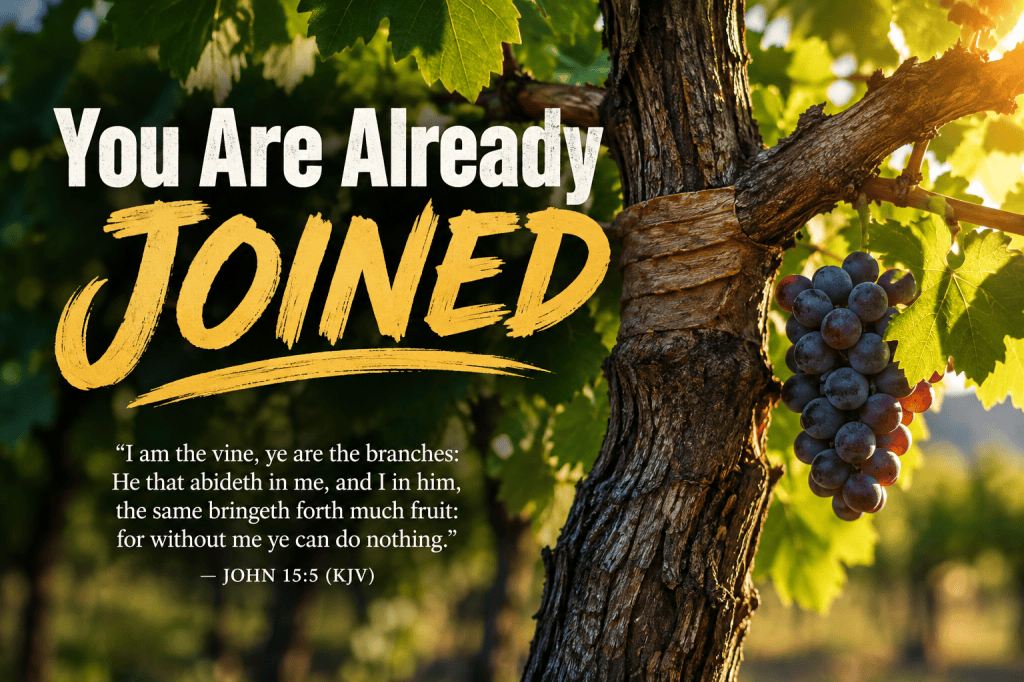
“I am the vine, ye are the branches: He that abideth in me, and I in him, the same bringeth forth much fruit: for without me ye can do nothing.”
— John 15:5 (KJV)
In the ancient world, a skilled vine dresser knew how to take a living branch and graft it into a strong, healthy vine. He would carefully open the vine, place the cut branch into the opening, and bind the two together so tightly that, over time, they became one living plant. Once the graft took, the branch no longer lived by its own life. The sap of the vine began to flow through it. From that moment on, the branch was not reaching for the vine. It was already joined to it. Its only responsibility was to remain where it had been placed.
That is the picture Jesus is giving in John 15:5.
The word “vine” is the Greek word ampelos. It is the ordinary word used for a grapevine—the living plant whose life-giving sap moves through every branch that stays connected to it. Jesus is saying, “I am the true, living source. You are the branches.”
The word “abideth” is the Greek word meno. It means to remain, to stay, to dwell, to continue in the same place without leaving. This is not the language of someone who is still trying to get closer. It is the language of someone who has already been joined and whose part is simply to stay. The one who meno—who remains in Him—and the One in whom he remains, that person brings forth much fruit. The life flows because the connection is real.
This is the same reality the apostle Paul describes when he uses the phrase en Christō—“in Christ.” It is not a general expression that means “somewhere near Jesus.” It speaks of a real, living union. When you believed, the Father grafted you into the Vine. His life—the same life that raised Jesus from the dead—began to move in you. You do not produce this life. You receive it, the way a branch receives sap. Your part is to remain where He has already placed you.
That is why Paul writes in 2 Corinthians 5:17, “Therefore if any man be in Christ, he is a new creature: old things are passed away; behold, all things are become new.” The phrase “in Christ” is en Christō. The words “new creature” are kainē ktisis. The word kainos does not simply mean new in time, as if something recent had been added. It means new in quality and kind—something of a superior order. And ktisis is the same word used for the act of creation itself. God did not take the old materials of your former identity and try to improve them. He made something that did not exist before. The old things are passed away. What remains is a member of Christ’s body, indwelt by His Spirit, alive with resurrection power.
The old identity that used to define you—the one shaped by your past, by failure, by the labels spoken over you—was crucified with Christ. It was buried. It has no claim and no living authority over you anymore. You are not a separate soul reaching toward Him from a distance. You are already joined to Him. The work is finished. Now believe it. Reckon it true. Let that truth govern how you see yourself when you wake up and how you move through your day.
You are in Christ. Christ is in you. That changes everything.
What does the phrase “in Christ” mean to you personally now that you have looked at these Greek words? How has this union begun to reshape the way you see yourself?


Leave a Reply