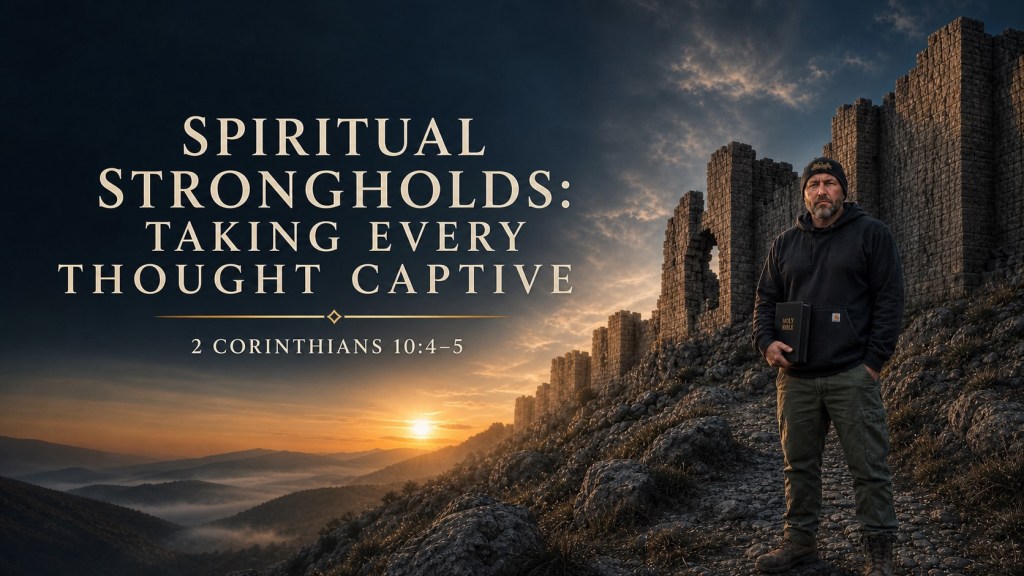
For the weapons of our warfare are not carnal, but mighty through God to the pulling down of strong holds; Casting down imaginations, and every high thing that exalteth itself against the knowledge of God, and bringing into captivity every thought to the obedience of Christ.
— 2 Corinthians 10:4-5
For over a thousand years, the ancient city of Constantinople stood behind the Theodosian Walls—a series of triple-layered stone fortifications so massive and so strategically engineered that they were considered the most impenetrable defensive structure in the ancient world. Enemy after enemy—Huns, Avars, Arabs, and countless others—hurled their armies against those walls for centuries and failed every single time. The walls simply would not fall. Constantinople earned a reputation as “the city that could not be conquered,” and for good reason: nothing in the ancient arsenal of warfare had ever been powerful enough to bring those fortifications down.
Then, in 1453, everything changed. The Ottoman army arrived not with the same old weapons that had failed for a thousand years, but with something entirely new: massive gunpowder cannons, including one so enormous it had to be transported by sixty oxen. These weapons were not “carnal” in the sense of ordinary military hardware—they represented a completely different category of power, one the ancient walls were never designed to withstand. Within weeks, cannon fire accomplished what a millennium of swords, siege towers, and battering rams could not. The unconquerable fortress fell, not because the walls became weaker, but because a superior weapon had finally arrived.
This is precisely what Paul is describing in Second Corinthians 10:4. The strongholds in your mind may feel exactly like the Theodosian Walls—fortified over years, tested by every ordinary attempt to tear them down, and seemingly unbreakable. Your own willpower, self-help techniques, and good intentions are like the outdated weapons that failed against Constantinople for a thousand years; they simply were not designed with enough power to bring down a true stronghold. But Paul says our weapons are not carnal—they are dunatos, mighty through God. Just as it took a fundamentally different class of weapon to finally topple Constantinople’s ancient walls, it takes the supernatural power of God’s Word and Spirit—not human effort—to demolish the strongholds fortified in your thinking.
The Weapons: Not Carnal, But Divinely Powerful
Paul begins verse 4 by identifying our “weapons.” The Greek word is hoplon, which was the common word for a soldier’s equipment—his sword, shield, and armor. Paul immediately clarifies that these weapons are “not carnal.” The word “carnal” is sarkikos, referring to something that belongs merely to the flesh—natural, human, unaided by the Spirit. In other words, you cannot win this particular war with willpower, positive thinking, or clever human strategy alone—just as a thousand years of ordinary siege weapons could never bring down Constantinople’s walls.
Instead, Paul says our weapons are “mighty through God.” The word “mighty” is dunatos, describing something powerful, capable, and able to produce results far beyond natural ability. This is the same word Paul uses in Second Corinthians 9:8 to describe God as “able” to make grace abound toward you, and again in Second Corinthians 12:10 when he says, “when I am weak, then am I strong” (dunatos). These are not ordinary weapons. They are supernaturally empowered instruments, provided by God Himself, engineered specifically “to the pulling down of strongholds”—the same way it took an entirely new class of weapon to finally topple a fortress that had stood unbeaten for a millennium.
Pulling Down: Total Demolition
The phrase “pulling down” comes from the Greek noun kathairesis, a rare word used only three times in the New Testament—here, and twice more later in this same letter. It describes complete, deliberate demolition—the kind of thorough destruction an army brings when it razes a fortified structure to the ground so it can never be rebuilt. This is not a minor renovation. Paul is describing total, permanent devastation of an enemy stronghold—the same finality that came when the walls of Constantinople finally gave way after a thousand years of standing firm.
Strongholds: A Fortress and a Prison in One Word
Now we arrive at the key word of this passage: “strongholds,” from the Greek ochuroma. This word appears only once in the entire New Testament, right here in Second Corinthians 10:4. It is one of the oldest military words in the Greek language, originally depicting a fortress, a castle, or a citadel—exactly like the Theodosian Walls described above. Ancient fortresses had thick, towering, impregnable walls built specifically to keep outsiders from scaling them or breaking inside.
But here is where the word study becomes truly fascinating. By the time of the New Testament, this same word ochuroma had also come to describe a prison. Since the most secure, heavily guarded prisons were typically built deep inside such fortresses, the very same Greek word came to represent both structures simultaneously. A fortress keeps outsiders from getting in. A prison keeps insiders from getting out. Do you see the double picture? The lies the enemy builds in your mind function exactly the same way—they wall off the truth from reaching you, and simultaneously wall you in, holding you captive to fear, shame, doubt, or false beliefs about yourself. Thayer’s Lexicon confirms this dual sense, noting that the word describes both a literal fortress and, tropically, “anything on which one relies”—including the arguments and reasonings a person uses to fortify a position and defend it against the truth.
The Septuagint uses this identical word to describe the famed fortified city of Tyre and other legendary strongholds—massive, seemingly unconquerable structures. That is the magnitude of what Paul is describing. These are not flimsy objections. They are deeply entrenched, heavily reinforced positions in your thinking, built brick by brick over time through repeated lies.
Casting Down Imaginations: The Word “Logic” Itself
Verse 5 begins, “Casting down imaginations.” The word “imaginations” is the Greek logismos—the very word from which we derive our English word “logic”. This is critically important because it tells us something the average reader would miss entirely: not every stronghold feels like an irrational fear. Some strongholds are built from cold, calculated, perfectly logical-sounding reasoning.
I call these “rational strongholds,” and they are actually more dangerous than irrational ones precisely because they make sense. Your natural mind will always produce sound-sounding reasons why you cannot obey God right now—why it isn’t the right time, why you can’t afford it, why the risk is too great. Meanwhile, “irrational strongholds” operate differently; these are unfounded fears and anxieties with no basis in truth—fear of disease, fear of premature death, abnormal fear of rejection. Whether logical or illogical, both types must be “cast down”—the Greek verb kathaireō, the same root behind “pulling down” in verse 4—demolished with the same forceful, military precision.
Every High Thing: Elevated Enemy Structures
Paul continues, describing “every high thing that exalteth itself against the knowledge of God.” The phrase “high thing” pictures an elevated structure—a watchtower or rampart built for defense, positioned high so its occupants can look down and resist anyone approaching with truth. Just as the defenders of Constantinople perched their towers high along the walls to spot invaders from a distance and appear unconquerable, the enemy attempts to construct elevated lies in your mind so he can rule you from a lofty position over your thoughts and emotions. These structures “exalt” themselves specifically “against the knowledge of God”—standing in direct, defiant opposition to what you know to be true from Scripture.
Bringing Into Captivity: Taking the Prisoner of War
Finally, Paul commands us to bring “into captivity every thought to the obedience of Christ.” “Bringing into captivity” is aichmalōtizō, a vivid military term picturing a soldier who has defeated an enemy combatant and now marches him away at spear-point as a prisoner of war. There is no negotiation with a captured prisoner—only compliance. This is precisely what you must do with every hostile thought: seize it, march it off the throne of your mind, and force it to submit “to the obedience of Christ”—hypakoē, meaning attentive listening that results in immediate compliance, like a soldier instantly obeying his commanding officer’s order.
The Fortress and Prison Set Free
When a person carries an unresolved stronghold, he lives inside invisible walls that function as both fortress and prison simultaneously. Like fortress walls, these lies insulate him from people trying to help him see the truth; like prison bars, they hold him captive to an illusion of bondage even after Christ has already purchased his freedom. If this describes an area of your life, the first step is recognition and repentance—acknowledging how the enemy gained this foothold in the first place. Then, rise up in the power of the Spirit, reject the enemy’s claim over that territory in Jesus’ name, and begin renewing your mind daily with the truth of God’s Word.
My Prayer for Today
Lord, I recognize that the enemy has tried to build fortified lies in my mind—some through irrational fear, others through logical-sounding reasoning that opposes what I know to be true about You. Today I pick up the mighty weapons You have given me, not weapons of the flesh, but weapons empowered by Your Spirit. Help me demolish every logismos, tear down every high thing exalting itself against Your knowledge, and take every thought captive to the obedience of Christ. I pray this in Jesus’ name!
My Confession for Today
I declare that my weapons are not carnal but mighty through God for pulling down every stronghold in my life! I take authority over every rational argument and every irrational fear the enemy tries to plant in my mind. My thoughts are captives marched into the obedience of Christ, and no fortress of lies can stand against the truth of God’s Word working in me. I declare this by faith in Jesus’ name!
Questions to Answer
- Can you identify a “rational stronghold” in your life right now—a logical-sounding argument that has kept you from obeying something God has clearly asked you to do?
- Is there an “irrational stronghold”—an unfounded fear or anxiety—that has held you mentally or emotionally captive, even though you know logically it isn’t rooted in truth?
- What specific scriptures can you begin confessing daily to demolish that stronghold and replace the enemy’s lie with God’s truth?
—Joshua L Mullins


Leave a comment