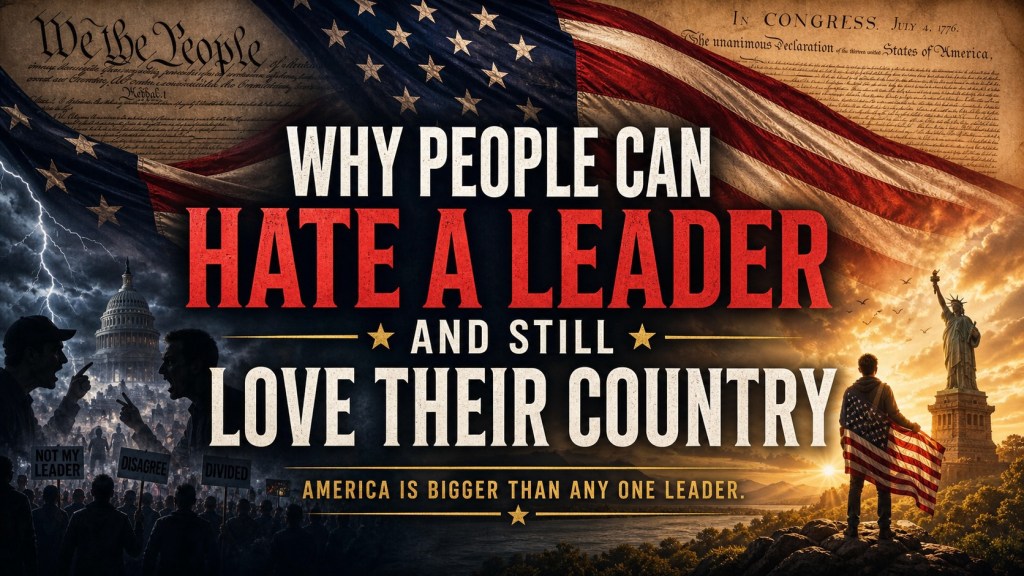
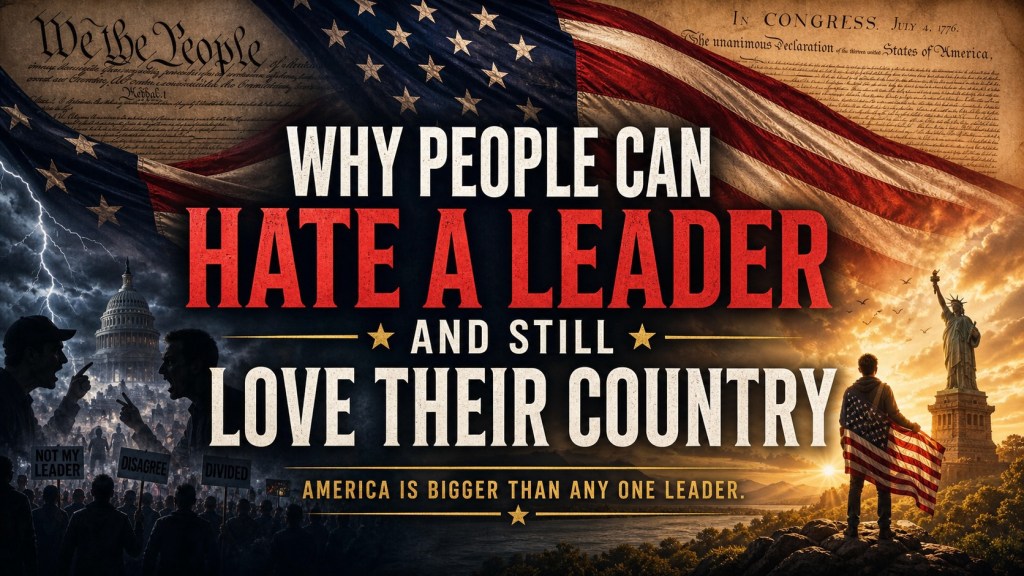
There is a major difference between disagreeing with a president and despising the country that gave you the freedom to disagree.
That distinction matters because today many people do not simply criticize a policy, oppose a leader, or argue against a political party. They attack America itself. They mock the flag. They sneer at the founding. They describe the country as evil, oppressive, racist, irredeemable, and broken beyond repair, all while enjoying the freedoms, protections, prosperity, and opportunity this nation provides.
That is not wisdom. That is ingratitude.
Of course Americans can disagree with leaders. That is part of the American system. No president, party, Congress, court, governor, mayor, or political movement deserves blind loyalty. But America is not one politician. America is not one election. America is not one administration. America is a nation built on an idea: that our rights come from God, not government, and that government exists to protect those rights, not create them, control them, or take them away.
So when someone says they hate America, the question must be asked clearly: do they hate a leader, or do they hate the very principles that make them free?
America Is Not Her Current Leaders
Presidents come and go. Congresses come and go. Supreme Court majorities change. Governors change. Parties rise and fall. Movements become popular and then fade. But the country is deeper than any temporary holder of power.
America is not Joe Biden, Donald Trump, Barack Obama, George Bush, Bill Clinton, Ronald Reagan, or any other president. America is not the Republican Party. America is not the Democratic Party. America is not Washington, D.C. America is a constitutional republic with a history, a people, a flag, a founding, a moral inheritance, and a set of principles that have endured through war, depression, corruption, failure, revival, reform, and sacrifice.
The National Archives identifies the Declaration of Independence, the Constitution, and the Bill of Rights as America’s “Charters of Freedom,” explaining that these documents secured the rights of the American people and helped define the founding philosophy of the United States (National Archives). That matters because America is not defined by the mood of the moment. America is defined by the principles in those documents.
The Declaration of Independence declares that all men are created equal, that they are endowed by their Creator with unalienable rights, and that governments derive their just powers from the consent of the governed (National Archives Declaration transcript). That means government is not God. Government is not the source of human dignity. Government is not the owner of our lives. Government is a servant under a higher moral law.
That is why Americans can oppose leaders without hating the country. In fact, sometimes opposing a leader is necessary because one loves the country.
Patriotism Is Not Blind Loyalty to Politicians
Patriotism does not mean pretending every leader is good. It does not mean defending every policy. It does not mean clapping for every law, every speech, every federal agency. That is not patriotism. That is political idolatry. It does not mean defending every war, every court ruling, or every party. True patriotism is loyalty to the country’s founding principles, not blind obedience to the people temporarily occupying office.
An American patriot can say, “I love this country, and that is exactly why I will not be silent when leaders violate the Constitution, attack liberty, abuse power, weaken the family, mock faith, endanger national security, or forget the people they are supposed to serve.”
That kind of criticism is not anti-American. It is deeply American.
The Constitution begins with the words “We the People,” and its stated purposes include forming a more perfect Union, establishing justice, insuring domestic tranquility, providing for the common defense, promoting the general welfare, and securing the blessings of liberty for future generations (National Archives Constitution). Notice what that means. The American system begins with the people, not the rulers. The Constitution does not say “We the politicians.” It does not say “We the elites.” It does not say “We the permanent bureaucracy.” It says “We the People”.
That is why loyalty to America cannot mean blind loyalty to whoever holds power. Our loyalty must be higher than party, higher than personality, and higher than political fashion. It must be loyalty to truth, liberty, justice, constitutional order, and the God-given rights this country was founded to protect.
Criticism Is Patriotic Only When It Calls America Back to Truth
There is a kind of criticism that strengthens a nation. There is also a kind of criticism that poisons it. The difference is not always the volume of the criticism. The difference is the goal.
If someone criticizes America because they want her to honor her Constitution, protect her people, defend liberty, pursue justice, respect faith, restrain government, and live up to her founding ideals, that criticism may come from love.
But if someone criticizes America because they hate her founding, hate her flag, hate her faith-shaped moral inheritance, hate free speech, hate religious liberty, hate private property, hate national sovereignty, hate equal justice under law, hate the Constitution, and hate the idea that rights come from God rather than government, then that is not reform. That is contempt.
America has flaws because Americans are human beings. Every nation on earth has sins, failures, corruption, and shameful chapters. The difference is that America was founded on principles strong enough to expose those failures and correct them. The same Declaration that announced equality exposed the contradiction of slavery. The same Constitution that created ordered government gave Americans a framework for amendment, reform, debate, and correction. The same First Amendment that protects religious liberty also protects the right to speak against injustice.
That is one reason America is still exceptional. She possesses within her founding principles the moral tools for self-correction.
Freedom of Speech Is Not Permission to Be Wicked
One of the ironies of anti-American speech is that people oen use American freedom to attack the country that protects their right to speak. But this must be understood correctly. Freedom of speech does not mean every word spoken is righteous, truthful, honorable, or patriotic. It means the government does not get to silence citizens simply because those citizens criticize leaders, challenge those in power, or hold unpopular views.
The First Amendment says, “Congress shall make no law… abridging the freedom of speech, or of the press,” and it also protects religion, peaceful assembly, and petitioning the government for redress of grievances (National Archives Bill of Rights transcript). That language was not written to make wicked speech honorable. It was written to keep government from becoming the master of every citizen’s conscience, opinion, argument, sermon, pamphlet, newspaper, or public protest.
The Library of Congress explains that founding-era definitions of freedom of speech and press differed, but the core idea was that people had a right to speak in public and private about intellectual and governmental issues without fear of government interference (Library of Congress). That is the constitutional point: the people must be able to criticize rulers because rulers must never be allowed to control all criticism of themselves.
But constitutional protection is not the same thing as moral approval. There is a line. When people celebrate assassination, mock the dead, cheer violence against political opponents, or say someone “deserved” to be murdered because of his beliefs, they have crossed a moral line. Even when such speech does not always meet the legal definition of a punishable threat, incitement, harassment, or conspiracy, it still reveals a diseased conscience.
A free republic may legally tolerate many offensive opinions, but it cannot remain healthy if its people lose the moral ability to condemn evil.
This is where many people become confused. America protects the right to speak because the state must not be trusted with unlimited power to silence the people. But America should never celebrate the abuse of that right. The Constitution protects the right to speak; it does not bless every use of the tongue.
So yes, a person may have legal protection to say something foolish, cruel, ungrateful, or anti-American. But that does not make the speech wise. It does not make it noble, patriotic. And it certainly does not make it righteous. It does not make it.
In many nations, citizens cannot freely criticize the government. They cannot openly challenge rulers. They cannot publish dissent, preach freely, assemble peacefully, or petition without fear. But in America, those rights are protected because the people are not supposed to be servants of the state. That freedom is not weakness. It is strength.
But strength without virtue becomes destruction. The right to speak does not erase the duty to speak truthfully. The right to criticize does not erase the duty to be decent. The right to oppose a leader does not create a right to celebrate murder.
The Founders Did Not Trust Concentrated Power
The American founders understood something many modern people forget: human beings are fallen, and power is dangerous.
That is why America was not designed as a monarchy. It was not designed as mob rule. It was not designed as rule by experts, judges, bureaucrats, or political celebrities. It was designed as a constitutional republic where power is divided, checked, limited, and accountable.
The Federalist Papers were written by Alexander Hamilton, James Madison, and John Jay in 1787 and 1788 to urge ratification of the Constitution and explain its structure (Library of Congress Federalist Papers guide).
In Federalist No. 51, Madison argued that government must be structured so each department can check the others, because government must first control the governed and then control itself (Library of Congress Federalist Papers guide).
That is not le wing or right wing. That is American.
The founders knew that no leader should be trusted with unlimited power. Not a king. Not a president. Not a Congress. Not a court. Not a majority. Not a political movement. Not even a leader people like. Especially not a leader people like.
That is why a citizen can say, “I oppose this leader,” and still be acting as a patriot. The real question is not whether one supports a particular politician. The real question is whether one supports the constitutional limits that protect the people from every politician.
America’s Greatness Is Not Canceled by America’s Failures
One of the most dishonest arguments in modern culture is the idea that if America has ever failed, then America is not worth loving.
By that standard, no nation, no family, no church, no movement, and no human being could ever be loved.
Love does not require perfection. In fact, mature love tells the truth about failure while still recognizing value.
America has had grave failures. Slavery was real. Injustice was real. Broken treaties were real. Racism was real. Corruption has been real. Moral decline is real. Abuse of power is real. But none of that erases the greatness of the principles America gave to the world.
The Declaration’s claim that rights come from the Creator remains powerful. The Constitution’s structure of limited government remains wise. The Bill of Rights remains one of the greatest protections of civil liberty in history. The sacrifices of soldiers, settlers, mothers, fathers, pastors, teachers, reformers, inventors, workers, and ordinary citizens remain worthy of honor.
America’s failures should make us sober. They should not make us ashamed of liberty.
The answer to America’s failures is not to destroy America. The answer is to return America to the best of what she was founded to be.
Loving America Means Defending What America Stands For
It is possible to live in America and not understand America. It is possible to enjoy the fruit while despising the root. It is possible to benefit from freedom while attacking the principles that produced it.
That is why patriotism must be more than emotion. It must be educated. To love America, one must understand what America stands for:
God-given rights, not government-created rights.
Government by consent, not rule by force.
The rule of law, not the rule of powerful people.
Free speech, not state-approved speech.
Religious liberty, not government-controlled conscience.
Equal justice under law, not favoritism for the powerful.
Limited government, not unlimited bureaucracy.
National sovereignty, not global submission.
Civic virtue, not selfish license.
Ordered liberty, not chaos disguised as freedom.
These are the principles that separate a free republic from tyranny.
If someone hates these principles, then their issue is not merely with a president. Their issue is with America itself.
A Christian View of Patriotism
For Christians, love of country must never become worship of country. The kingdom of God is higher than the United States of America. Christ is Lord, not Caesar, not Congress, not the Supreme Court, not the president, and not the flag.
But that does not mean Christians should be indifferent to the nation where God has placed them. Gratitude is not idolatry. Thankfulness for liberty is not worship. Honoring sacrifice is not nationalism. Defending religious freedom is not extremism. Wanting children to learn the truth about their country is not propaganda.
A Christian can love America while knowing America is not the kingdom of God. A Christian can honor the flag while worshiping only the Lord. A Christian can thank God for constitutional liberty while remembering that no earthly government can save the soul.
The right kind of Christian patriotism says: “This country is not my god, but it is my stewardship.”
That means Christians should pray for leaders, speak truth, defend righteousness, protect liberty, teach history, resist tyranny, honor sacrifice, and refuse to surrender the nation’s memory to those who hate it.
“If You Don’t Like It, Leave” Is Not Always Enough
It is understandable when people say, “If you hate America so much, why do you stay here?” That question has force. If someone truly believes America is irredeemably evil, while continuing to enjoy its freedoms and prosperity, the contradiction is obvious.
But there is also a better challenge: if you love America, help restore her.
Do not just complain. Teach. Vote. Build. Serve. Pray. Raise children who know the truth. Read the founding documents. Study the Constitution. Honor veterans. Support good leaders. Hold bad leaders accountable. Speak with courage. Refuse to let schools, media, activists, or politicians define America only by her failures.
America does not need citizens who merely wave flags on holidays and forget the Constitution the next day. America needs citizens who understand what the flag represents.
What We Must Teach the Next Generation
If Americans do not teach their children what America is, someone else will teach them to hate it.
Children should learn the Declaration of Independence. They should learn the Constitution. They should learn the Bill of Rights. They should learn why freedom of religion matters. They should learn why speech must be protected even when speech is unpopular. They should learn why government must be limited. They should learn why the family matters. They should learn why citizenship requires duty, not just entitlement.
They should also learn that liberty requires virtue. A people cannot remain free if they become dishonest, ungrateful, ignorant, cowardly, lawless, or morally confused. Self-government requires self-control.
Early American education oen connected literacy, moral instruction, biblical memory, and character formation. The Library of Congress preserves The New England Primer as an early American schoolbook, and it remains important for understanding how early generations connected reading, faith, manners, discipline, and civic formation (Library of Congress).
Modern America does not need to copy every colonial method. But modern America does need to recover the conviction that education is not merely about job skills. Education is about forming people who can live responsibly in freedom.
The Real Test
So can a person hate a leader and still love the country?
Yes.
A person can hate corruption and still love America. A person can oppose a president and still honor the Constitution. A person can reject a policy and still respect the flag. A person can criticize a court decision and still cherish the republic. A person can grieve over national sin and still thank God for national blessing.
But a person cannot hate America’s founding principles and honestly claim to love America. If someone hates the Declaration, the Constitution, the Bill of Rights, the flag, religious liberty, free speech, national sovereignty, equal justice, limited government, and the idea that rights come from God, then that person does not merely hate a politician. That person hates the foundations of the country.
That is the line.
Criticism that calls America back to her principles can be patriotic. Contempt that seeks to destroy those principles is not.
Closing Reflection
America is not perfect. No honest patriot has to pretend otherwise.
But America is still worth loving. America is still worth defending. America is still worth teaching. America is still worth correcting. America is still worth preserving.
To love America is not to worship her leaders. It is to defend her principles. It is to know the difference between a flawed politician and a priceless republic.
It is to say, with gratitude and conviction, that this country has been blessed, tested, attacked, defended, corrected, and preserved by the mercy of God and the sacrifice of generations.
And it is to teach the next generation this simple truth:
You can hate what a leader does and still love America. But if you hate the freedoms, the founding, the Constitution, the flag, the sacrifice, and the God-given rights that made this nation possible, then your problem is not with a leader. Your problem is with America.
—Joshua L Mullins
More to come in this ongoing series on the Constitution and the history of America.



Leave a Reply