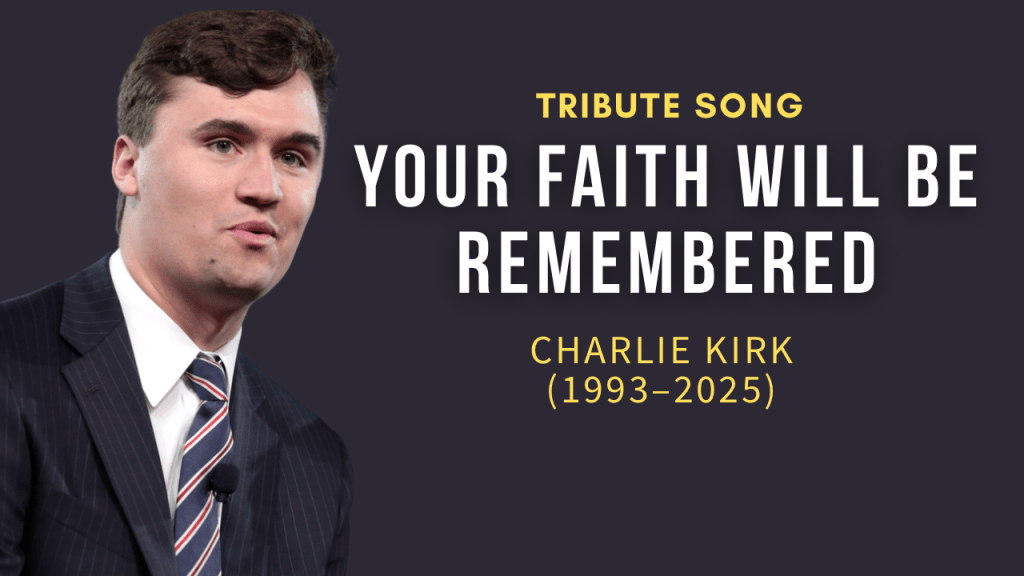
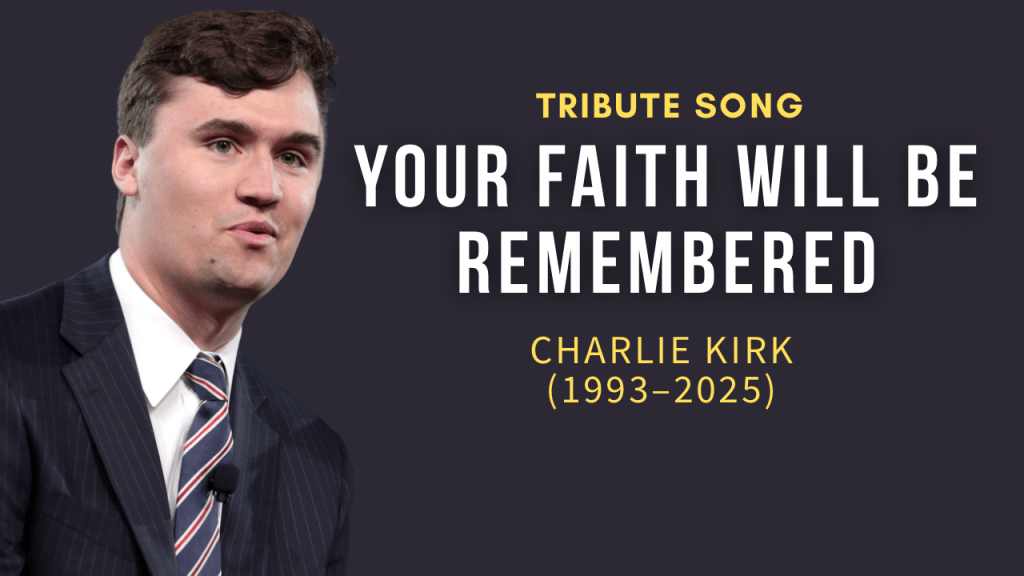
I wrote Your Faith Will Be Remembered because grief and gratitude arrived at the same time. In so many settings—on stages, in interviews, in conversations—Charlie kept steering people back to Jesus. Whatever you thought about his politics, his compass was public: Christ first. This song is my small attempt to honor that.
What the song means
It begins softly—like a prayer whispered after a long day. The first verse sits in the tension of loss and thanks: we miss you, and we thank God for the time we were given.
The chorus rises as a promise: your faith will be remembered—not because of headlines, but because faith bears fruit in people.
The bridge is a charge to those of us still here: build a life that lasts; love your church and your family; speak truth with grace; keep pointing people to Jesus—even when the conversation gets hard.
What people have been saying (paraphrased)
As tributes poured in from leaders, friends, and ordinary listeners, a few themes kept repeating. I’m not quoting word-for-word here—just capturing the heart of what many expressed:
He made courage contagious. Even people who disagreed with him admitted he stood his ground without flinching. He kept the main thing the main thing. In the middle of public debate, he spoke openly about Scripture, prayer, and the hope of the Gospel. He carried conviction and still called people higher. Firm in truth, but insistent that every person bears God’s image. He loved his country—and he loved Jesus more. That order mattered to him. He wanted to be remembered for his faith. The way he lived (and spoke) made that clear.
The invitation
If Charlie’s life helped you stand up straighter, take that with you. Go back to church. Strengthen your family. Tell the truth with a steady voice. Live so that, when your story is told, people are led to Christ. That is the legacy this song tries to carry.
Watch the full song:
— Joshua L. Mullins (2025)
Unofficial tribute; not affiliated with the family, estate, or TPUSA.
Image credit (if you use a Commons portrait):
Photo: Gage Skidmore, via Wikimedia Commons (CC BY-SA 2.0). Changes: crop, color grade, text. Our page is licensed under CC BY-SA 2.0.


 Faith Works
Leave a reply to myallaboutyou Cancel reply