By Joshua L Mullins
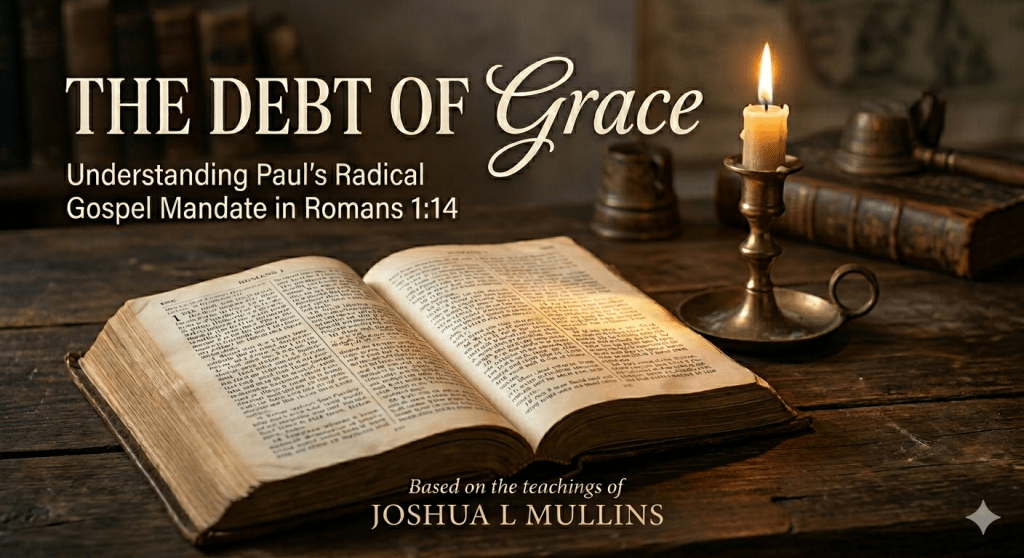
Have you ever felt the crushing weight of a debt you couldn’t pay? Perhaps it was a mortgage that seemed to grow every month, or a loan that kept you up at night. We spend our lives trying to get out of debt. We want to be free, beholden to no one. But when we open the Word of God to the first chapter of Romans, we find the Apostle Paul declaring that he is moving in the exact opposite direction. Paul doesn’t say he is debt-free. In fact, he stands before the sophisticated world of Rome and makes a staggering confession: “I am under obligation.” Friends, this is one of the most significant statements in all of Scripture. It reveals the heart of a man who understood that the grace of God isn’t just a gift to be enjoyed—it is a stewardship to be shared. In Romans 1:14-16, Paul gives us three “I am” statements that define the Christian life:
- “I am under obligation” (The Debt)
- “I am eager” (The Desire)
- “I am not ashamed” (The Defense) Today, I want us to look closely at that first declaration. I want us to understand why Paul felt he owed a debt to people he had never even met.
The Definition of a Debtor
When Paul says he is “under obligation,” he uses a very specific Greek word: opheiletes. In the marketplace of the first century, this was the word for a legal debtor—someone who owed cold, hard cash. It described a person bound by a moral and legal duty. Now, think about this. Paul didn’t owe the Romans money. He didn’t owe the Greeks a favor. So why did he feel like a debtor? It’s because Paul understood a principle that many of us miss today: Grace creates a responsibility. When God saved Paul on the road to Damascus, He didn’t just give him a ticket to heaven. He gave him a treasure for the world. Paul realized that if he kept the Gospel to himself, he was essentially stealing from those who hadn’t heard it yet. He was like a man who had found the cure for a global plague; the moment he held the medicine in his hand, he became a debtor to every dying person on the planet.
A Debt to Every Soul
Notice the scope of Paul’s debt. He says he is obligated to the “Greeks and to barbarians,” to the “wise and to the foolish.” In that culture, the Greeks were the “inner circle.” They were the educated, the refined, the intellectual elite. The “barbarians” were the outsiders—those who didn’t speak the language or share the culture. By using these terms, Paul is telling us that the Gospel has no borders.
- It is for the Professor in the ivory tower and the Pauper on the street corner.
- It is for the Religious man and the Rebel.
- It is for the Sophisticated and the Simple. You see, sin is the universal disease, which means the Gospel must be the universal cure. Paul looked at every person—regardless of their status, their education, or their background—and saw someone to whom he owed the truth of Jesus Christ.
The Turning Point of Stewardship
I’ve often said that the greatest tragedy in the church today is the “Dead Sea Christian.” You know the geography of the Holy Land—the Sea of Galilee receives water and gives water, and it is full of life. But the Dead Sea only receives. It has no outlet, and as a result, it is stagnant and lifeless. Many believers are like that. They take in the sermons, they take in the books, they take in the blessings—but they never let it flow out. Paul was a conduit, not a reservoir. He knew that the grace he received was meant to pass through him. When you truly encounter the living Christ, your focus shifts. You stop asking, “What can God do for me?” and you start asking, “Who can I tell about Him?” That concern you feel for your lost neighbor, that burden you have for your unsaved family member—that isn’t just a feeling. That is the debt of grace.
Are You Settling the Account?
As we look at our own lives today, we have to ask ourselves: Do we feel the weight of this obligation? Do we see the people in our workplace, our neighborhoods, and our schools as people to whom we owe a debt? Paul’s life was a “Turning Point” for the history of the world because he refused to live for himself. He lived to settle the debt. He risked shipwrecks, beatings, and imprisonment because the message was too precious to keep silent. My friend, you and I may never be an Apostle Paul. We may never travel the world planting churches. But we have the same Spirit and the same Gospel. And if we have been rescued by grace, we are under the same obligation. Let us live with the same urgency that drove Paul. Let us be people who can say, along with him, that we are not just recipients of the Gospel—we are its messengers. And when you realize you are a debtor, it leads you to the next step: a heart that is truly eager to share the Good News.
 Faith Works
Leave a comment