Damascus, the Road, and the Moment a Slave Changed Masters
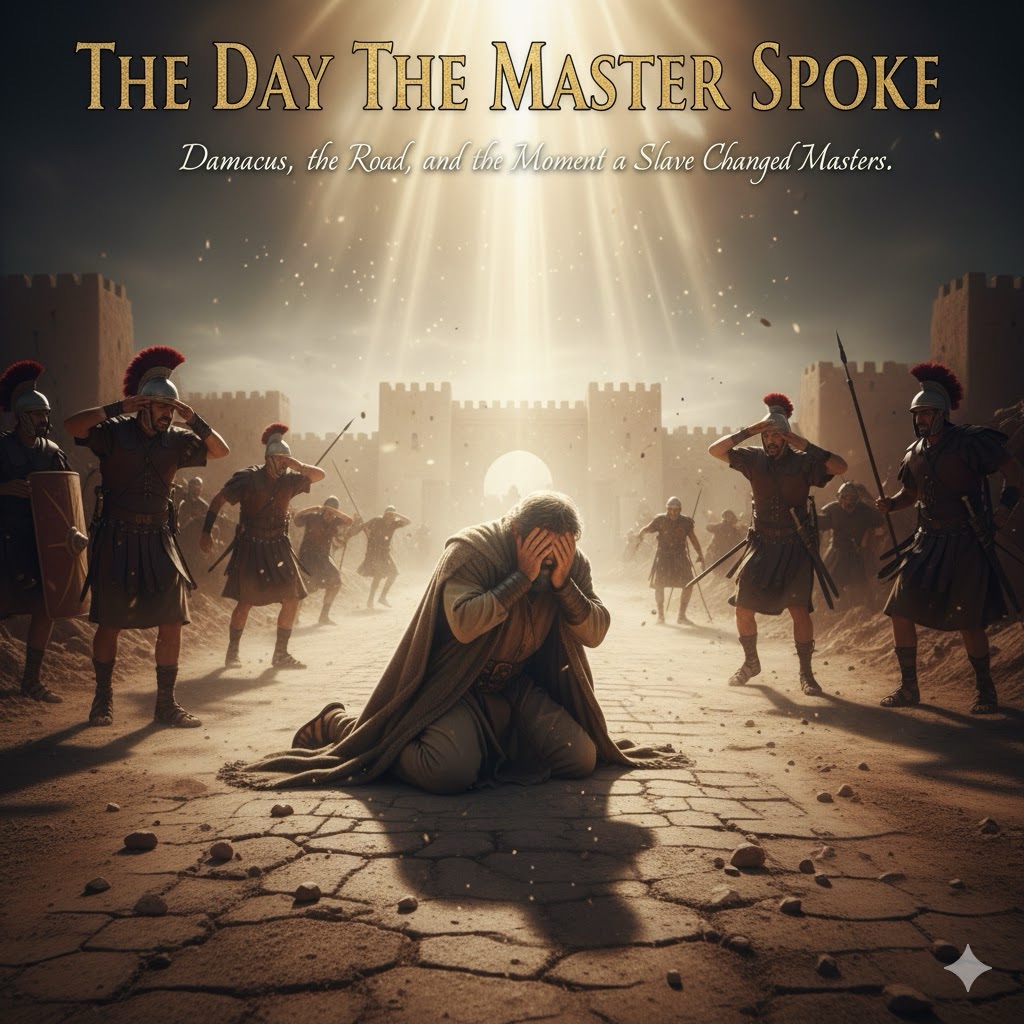
By the time Saul saw Damascus, it was not just a name in the prophets; it was a living city of stone and dust and gods. An oasis city, older than Israel’s kings, ringed with walls and gates, fed by the waters of the Barada, it lay like a green jewel in the brown of Syria. Roman eagles watched from towers. Soldiers in armor moved through the gateways. Merchants shouted in Greek and Aramaic. The smoke of sacrifices rose not only from Jewish homes but from pagan temples—Hadad once, now Jupiter, storm-god renamed and enthroned in stone.
Cut straight through the heart of that old city ran the pride of Roman planning: the east–west boulevard they called Via Recta—Straight Street. It was the mile-long spine of Damascus, the decumanus maximus, lined with columns, arches, shops, stalls, and doorways. From one gate of the city to the other, that straight line carried traders, soldiers, priests, and, on this particular week, a blind Pharisee led by the hand to a house that faced the street.
That is where God was taking him. But first, God met him on the road.
Saul was not walking toward Damascus as a tourist. Luke says he was “still breathing threats and murder against the disciples of the Lord” as he went to the high priest and obtained letters to the synagogues in Damascus, so that if he found any belonging to the Way, men or women, he could bring them bound to Jerusalem (Acts 9:1–2). Those letters were rolled and sealed somewhere in his cloak or satchel as he walked. The wax carried Jerusalem’s authority; the handwriting carried the names of men who ruled in the temple courts. In Saul’s mind, those letters were the proof that God and the guardians of the Law were behind him.
He already belonged to that world. Pharisee of Pharisees, disciple of Gamaliel, zealous for his ancestral traditions, advancing beyond many of his own age (Philippians 3:5–6; Galatians 1:14). Josephus would later describe the Phariseesas the strictest sect, famed for their careful interpretations, influential among the people, “the most accurate interpreters of the laws.” Saul was one of those accurate interpreters. In his own eyes, he was the man with the clearest vision in Israel.
So you have to see him like this: a small figure in a desert landscape, moving steadily north. The heat presses down; sandals kick up thin clouds of dust. In his mind, the road ends inside the synagogues of Damascus, where he will stand as the righteous defender of the covenant and announce warrants in the name of the high priest. If you had asked him, “Whose slave are you?” he would have answered without hesitation: “The God of our fathers. I serve His Law.” He does not yet see that sin is using that Law as a chain and that his zeal has made him a servant of death (Romans 7:9–11).
As the city’s walls begin to rise in the distance, the true Master steps into the story.
Luke tells it without ornament because the event needs none: “As he was traveling, it happened that he was approaching Damascus, and suddenly a light from heaven flashed around him; and he fell to the ground…” (Acts 9:3–4). One heartbeat he is walking; the next he is swallowed in light. This is not desert glare; this is the kind of light that once filled the tabernacle so that Moses could not enter (Exodus 40:34–35), the kind that wrapped Sinai in cloud and fire when the LORD came down and the mountain shook (Exodus 19:16–19), the kind Peter will later say he saw on the mountain when Christ’s face shone like the sun (2 Peter 1:16–18).
Saul has read those texts all his life. Now the same quality of light explodes around his body. His knees do not ask his permission. He drops. The road that carried his mission becomes his floor. Dust coats his face. The letters he treasured as holy authority are now somewhere in the dirt behind him. The man who walked into houses and made others fall now lies as low as any of them.
Then the Voice comes.
“Saul, Saul, why are you persecuting Me?” (Acts 9:4). His name, twice. Scripture only spends that double calling on people at turning points: “Abraham, Abraham” on Moriah, knife in hand (Genesis 22:11); “Moses, Moses” before the bush that burned but was not consumed (Exodus 3:4). The repetition carries weight. Heaven is not correcting a small mistake. Heaven is interrupting a life.
But the real wound is in the last word: “Me.”
Saul has seen faces in doorways, men and women he dragged away; he has seen Stephen’s face shining like that of an angel as stones flew (Acts 6:15; 7:58–60). He has framed them as blasphemers, traitors, a disease in Israel. The Voice from the glory says he has been persecuting someone he has not seen. To chain these people is to lay chains on Christ Himself. The union between Christ and His body is not a figure of speech; it is close enough that the Lord of heaven says, “You touch them, you are touching Me” (1 Corinthians 12:12–13).
For the first time in the record, the man who always had an answer has only a question. Face in the dust, blinded by glory, he says, “Who are You, Lord?” (Acts 9:5). He knows this is “Lord”—the God of Abraham who spoke to Moses and the prophets. But the “who” has come loose. He has known the stories, the commands, the temple. He has not known the One standing behind them.
The reply is the sound of his old world cracking down the middle.
“I am Jesus whom you are persecuting” (Acts 9:5).
Jesus. The name he has spat from his mouth, the name written on the lips of the people he came here to arrest, the name Stephen called as he died—“Lord Jesus, receive my spirit” (Acts 7:59). That name now comes out of the center of the light that belongs to Israel’s God. Not “I am the LORD and you have been hard on My followers.” “I am Jesus.” The crucified Man Saul is certain died under the curse of the Law (Deuteronomy 21:23) is standing in the place of the Lawgiver.
This is where the theology of Galatians and Romans is born in his bones. Later he will write, “through the Law I died to the Law, so that I might live to God” (Galatians 2:19), and confess that what he once counted gain he now counts as loss, rubbish, compared to knowing Christ (Philippians 3:7–9). On this road, that death happens in an instant. The Law he thought he was serving steps aside and shows him the One it was pointing to all along, and Saul suddenly realizes he has been using the holy commandment as a sword against the very righteousness of God revealed in Christ (Romans 1:17; 10:3–4).
Centuries later, Martin Luther would sit in his monastery quarters in Germany and, reading Romans 1:17, come to the same shock in a different setting. He described it as though “the doors of paradise swung open and I walked through,” when he discovered that the righteousness of God in the gospel is a gift, not a whip. Saul’s gate is not a cloister door; it is this burst of light and this sentence: “I am Jesus.” The slave of the Law has just heard the voice of the real Master and found out he has been striking His household.
When the light draws back, judgment remains. “Saul got up from the ground, and though his eyes were open, he could see nothing” (Acts 9:8). The man who saw himself as a guide to the blind must now be led by the hand into the city. The road he thought he commanded is now a rope in someone else’s fingers. Those with him—perhaps temple officers, perhaps young men eager to prove themselves—now take him by the arm like a child and walk him through the gate he meant to enter as a hunter. His body is preaching his condition: you have never seen; you are only now discovering it. For three days he is blind, and in that time he neither eats nor drinks (Acts 9:9). The zealot who burned with action sits still. The accurate interpreter of the Law is quiet.
Inside the city, life goes on. On Straight Street, columns cast their morning shadows; traders haggle in doorways; Roman soldiers clank past; a priest of Jupiter crosses the square; a Jewish father leads his children toward synagogue. Somewhere, behind a doorway along that long stone street, is a house owned by a man named Judas. That is where they bring Saul. The decumanus maximus of Rome’s design—one long, measured line from east to west—now has, in one of its houses, a man whose life has just been bent into an entirely new direction.
While Saul sits in the dark, the same Jesus speaks somewhere else in the city—this time not in blinding splendor but in a vision to a disciple whose name does not appear in Josephus or Roman records but is forever written in Acts: Ananias. The Lord calls him by name, and he answers, “Here I am, Lord” (Acts 9:10). The instructions are specific: go to Straight Street, to the house of Judas, and ask for a man from Tarsus named Saul, “for he is praying,” and in a vision Saul has seen a man named Ananias come in and lay hands on him so that he might regain his sight (Acts 9:11–12).
Ananias knows the reputation. “Lord, I have heard from many about this man, how much harm he did to Your saints at Jerusalem; and here he has authority from the chief priests to bind all who call on Your Name” (Acts 9:13–14). You can imagine him picturing the same letters Saul dropped in the dust: rolled parchment with the seal of the high priest, sitting somewhere in that house. He feels the weight the whole church feels. The most dangerous man in their world is blind, but he is still Saul.
The Lord answers with words that tell you the ownership has already changed: “Go, for he is a chosen vessel of Mine, to bear My Name before Gentiles and kings and the sons of Israel; for I will show him how much he must suffer for My Name’s sake” (Acts 9:15–16). “Vessel of Mine.” In that phrase is the seed of “Paul, a slave of Christ Jesus, called as an apostle, set apart for the gospel of God” (Romans 1:1). The man who had been a vessel of the Law, a tool of sin, an agent of death, has been seized. He will still serve; he will still carry; but now he will carry Christ’s Name to Gentile markets, royal courts, and Israel’s synagogues.
So Ananias steps onto Straight Street. Imagine him walking under the colonnades, passing shopfronts and arches that have seen centuries of traffic, until he stands at the doorway of Judas’s house. Inside, the feared Pharisee sits in the dimness, hungry, sightless, praying words he has never prayed before. Ananias enters, stands before the man whose name mothers whisper to their children, and does not say, “Now you know how it feels.” He lays his hands on him and speaks two words that crack the stone of Saul’s old life in a new place: “Brother Saul” (Acts 9:17).
Brother. The church he tried to destroy calls him family. The body he tore receives him as a member. The Lord he opposed sends him a man whose only weapon is touch and a message: “The Lord Jesus, who appeared to you on the road by which you were coming, has sent me so that you may regain your sight and be filled with the Holy Spirit” (Acts 9:17). The Jesus of the light and the Jesus of the quiet room are the same Lord. The Master who knocked him down now sends comfort into the room through another servant’s hands.
“Immediately there fell from his eyes something like scales, and he regained his sight, and he got up and was baptized” (Acts 9:18). The blindness that told the truth about his soul drops to the floor. He sees again—city walls, the lines of Straight Street, the face of the man who just called him brother—but everything is different. The Law he thought would save him has been shown to be powerless to justify; the crucified Jesus he thought God had cursed is revealed as Lord and Christ. He stands up and goes down into water. In that baptism he agrees with what has already happened on the road: the old Saul has died with Christ; a new man rises to live by faith in the Son of God (Galatians 2:20; Romans 6:3–4).
For those believers in Damascus, this is what Acts compresses into a simple line: “for several days he was with the disciples who were at Damascus” (Acts 9:19). It would be like hearing that the man who signed the execution orders for your family—the Hitler, the Stalin, the secret-police chief of your world—is not only in your city, but now sitting at your table, blind once, now seeing, breaking bread and blessing the Name he once cursed. Only a greater King could rewrite a story that violently.
That is Article 2. Not background in a textbook, but a day on a real road and in a real city—dust, gates, columns, letters in the dirt, a dark room above a Roman street—where the slave of the Law lost his old master and came out of the water as a slave of Christ. From here, when he later sits down to begin a letter and writes, “Paul, a slave of Christ Jesus…,” he is not choosing a pious phrase. He is remembering that light, that Voice, that street, that hand on his shoulder, that water, and the moment when the true Master spoke his name and took him as His own.
—Joshua L Mullins


 Faith Works
Leave a comment