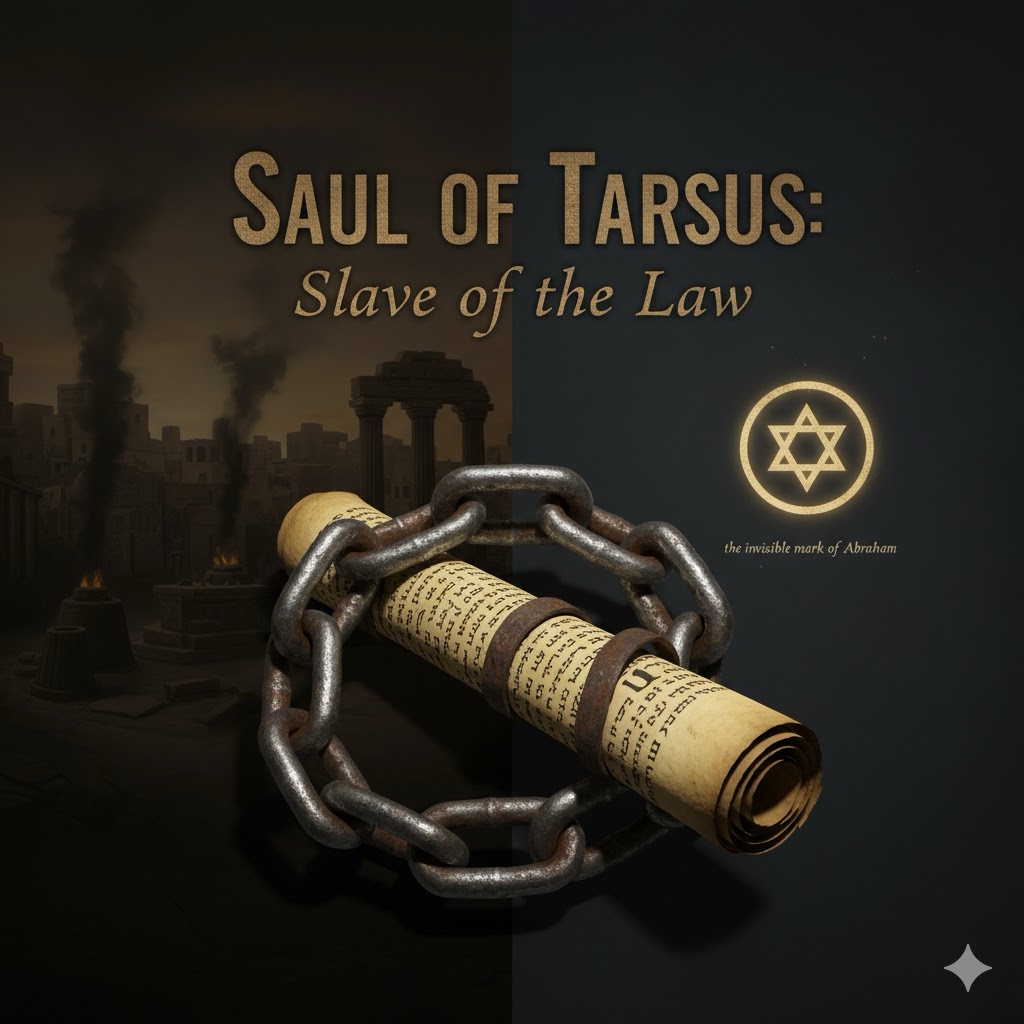
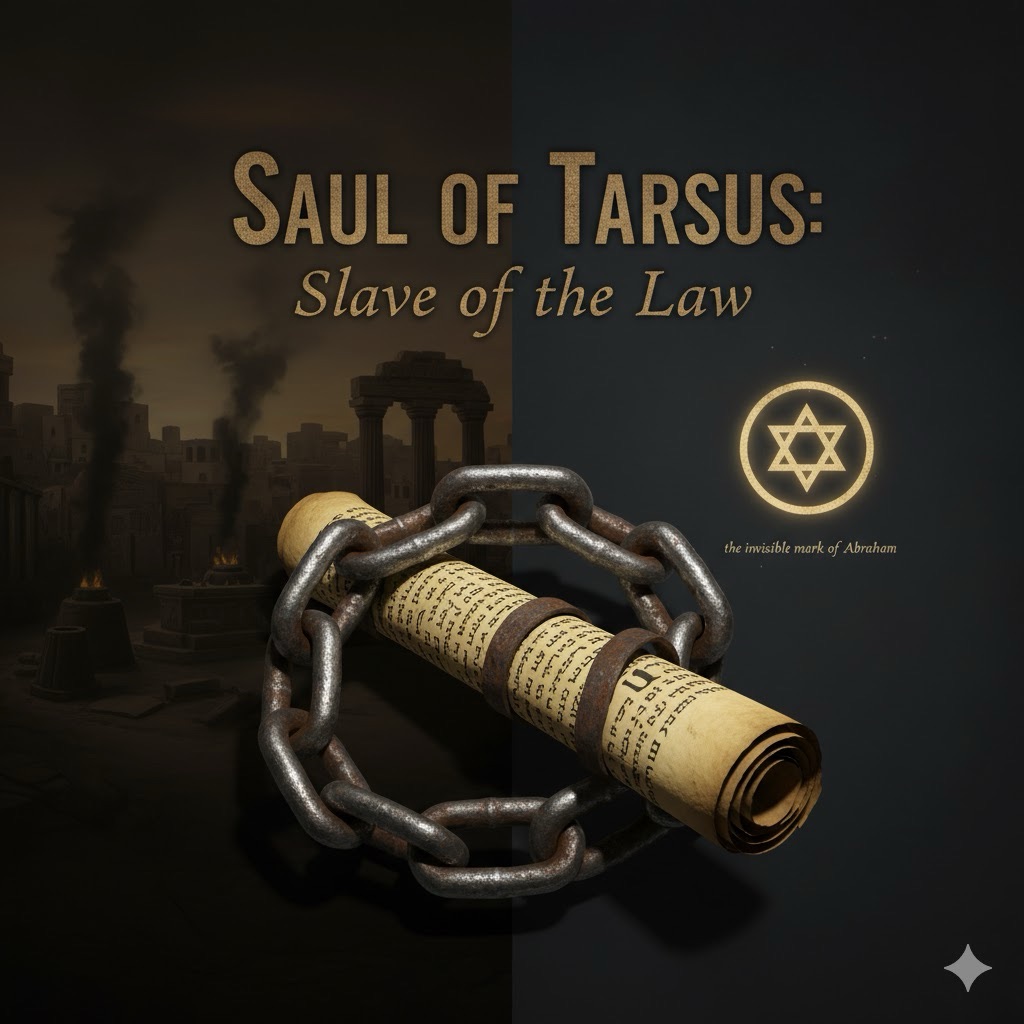
Before there was “Paul, a slave of Christ Jesus,” there was a boy named Saul who learned early how to wear chains and call them righteousness.
Picture a city by the sea: Tarsus, in Cilicia. The docks are crowded with ships from Egypt, Greece, Syria. Sailors shout in foreign tongues. Stoic philosophers stroll under colonnades. Roman officials in bright-bordered togas move through the streets with the quiet arrogance of power. Pagan shrines stand at street corners, smoke curling into the sky.
And somewhere in that city, behind a door marked not with an idol but with the invisible mark of Abraham, a Jewish family keeps the Sabbath.
Inside, a child’s world is already divided. Out there is Rome’s world—idols, uncleanness, Gentile power. In here is the world of Torah—the God of Abraham, Isaac, and Jacob; the covenant; the stories of Egypt and Sinai; the promises to David. The boy grows up hearing two languages: the harsh Latin of soldiers, the smooth Greek of trade—and the holy Hebrew of Scripture.
The boy’s name is Saul.
He is not raised to be casual about God. He is raised to be bound.
From his earliest days he hears words like “set apart,” “circumcised,” “clean,” “unclean.” He learns that his people are different, holy, marked. He learns that the Law is not suggestion; it is command. Every morning and evening he hears the Shema: “Hear, O Israel: the LORD our God, the LORD is one; you shall love the LORD your God…” Love is commanded, but it comes to him wrapped in requirements.
When other boys run wild, Saul is taught the yoke of the Law.
Scrolls are unrolled before him. He traces letters with his finger. He memorizes commandments. He learns the fence of extra rules built around the Law by the elders—“just to be safe.” The more he learns, the more he feels both pride and pressure. To belong to this people is to be under a weight.
In Tarsus he is also a Roman citizen, a rare privilege for a Jew. That status will one day give him legal protection, but even now it means he lives between worlds—legally inside Rome, religiously outside it. In a city filled with free men and slaves, his heart is beginning to serve a different master, though he does not yet see it: the Law itself.
At some point Saul is sent to Jerusalem—to study under Gamaliel, one of the most respected rabbis of the day. This is the dream of every serious Jewish family: their son at the feet of the great teachers, in the shadow of the Temple, breathing the air of tradition. Jerusalem is the beating heart of everything he has been taught to love.
Here the chains get heavier.
In the narrow streets around the Temple, Saul enters the strict world of the Pharisees. These are not casual synagogue men. They are the separated ones, men who have sworn to keep the Law in its smallest detail. They tithe garden herbs. They strain wine to avoid swallowing a gnat. They rehearse purity rules for every situation. Their lives are one long “you shall” and “you shall not.”
Saul excels.
Later he will describe himself as “a Hebrew of Hebrews; as to the Law, a Pharisee; as to zeal, a persecutor of the church; as to righteousness which is in the Law, blameless.” He is not boasting in laziness; he is boasting in bondage. He has become what his world praises most: a man possessed by the Law.
Watch him as a young man in Jerusalem.
He rises before dawn to recite prayers. He washes hands in ritual water, careful to let it drip the right way. He studies until his eyes ache, wrestling with arguments of the rabbis. He walks the courts of the Temple with the stiff, careful bearing of a man always conscious that a holy God is watching.
Outwardly, he glows.
Inwardly, something else is growing.
The Law he serves is holy. It comes from God. But it has met a heart made of Adam’s clay. Under its commands, hidden desires stir. Saul learns the commandment “You shall not covet,” and suddenly he realizes that the Law does not only forbid actions; it reaches into thoughts, urges, secret wants.
The Law says “Do not,” but his nature answers with, “But I want to.”
And then shame speaks: “A real man of the Law wouldn’t even feel this. What’s wrong with you?”
He doesn’t say that part out loud. He doubles down.
If something inside feels restless, he will answer it with more Law. More rules. More zeal. More cleanliness. More separation from sinners. More passion against anyone who seems to dishonor Moses. He becomes, in his own words, “extremely zealous” for the traditions of his fathers.
Here is the tragedy: he has the Scriptures, but not yet the light of the One they point to. He knows the commandments, but not yet the Deliverer. He wears the Law like a chain and calls it his crown.
If you could see Saul’s soul at this stage, Martin Luther would recognize him.
Martin Luther, centuries later, would describe his own monastery life as a prison of self-righteousness—fasting, confessing, punishing himself, trying to wring righteousness out of his flesh by force. Saul is doing the same in Phariseeclothing. He is driven, sincere, fierce. He is also bound.
You can hear the chain-rattle under his later words in Romans 7, when he speaks of a man who delights in the Law of God in his inner man and yet sees another law at work in his members, waging war and making him a prisoner. When he writes that, he is not painting an abstract sinner; he is remembering himself.
In Jerusalem, Saul’s slavery starts to show its teeth.
A new group appears: a sect that claims Messiah has come, that He was crucified, and that He rose again. They proclaim forgiveness of sins and justification by faith apart from works of the Law. They meet in homes, break bread, and speak of Jesus as Lord.
To a man like Saul, this is not interesting; it is intolerable.
If these people are right, then all his striving has been misguided. If righteousness comes through this Jesus, then his ladder of commandments does not reach heaven at all. The cross of Christ means the end of salvation-by-striving. It means the Law has been fulfilled by Another. It means his entire identity has to die.
Rather than entertain that possibility, his slavery does what slavery always does when threatened: it defends its master.
He becomes a hunter.
He stands in the crowd when Stephen is stoned and approves the execution. He watches the first martyr fall under a hail of rocks and feels not guilt, but vindication. He breathes threats and murder against the disciples. He drags men and women out of their homes to be imprisoned. He persecutes the church “beyond measure,” trying to destroy it.
This is what a slave of the Law looks like at full speed.
It is not peace. It is not joy. It is compulsion. It is the flesh using holy things as weapons. It is sin taking the commandment and using it as a spear. It might wear religious robes, quote Scripture, and pray long prayers, but beneath the surface is a heart that does not rest in the love of God—it strives, climbs, and attacks anyone who threatens its system.
Saul’s nights in those days would have been loud.
You can imagine him lying awake, reviewing the day. Did I keep the commands? Did I miss a rule? Did I tolerate blasphemy? Did I protect Moses? The Law does not say, “It is finished.” The Law says, “Do this and live.” Every day becomes a new trial. Every failure feels like a sentence. Every success feels fragile.
He is, in modern words, utterly religious and utterly unfree.
That is the man who will one day write Romans. Not a man who grew up gentle, dabbling in ideas, choosing Jesus like one more spiritual option. A man who knew what it meant to be owned by something: owned by a system, by a code, by the fear of falling short, by the pride of being right.
The irony is sharp: in a world where thousands wear physical chains, Saul wears invisible ones and calls them holiness.
He would have walked through Jerusalem and despised the slaves of Roman households, the Gentile soldiers, the common people who did not keep the Law as strictly as he did. He did not realize that in heaven’s eyes, his own soul was shackled more tightly than any pagan’s wrists.
If you want to understand why “Paul, slave of Christ Jesus” in Romans 1:1 is so powerful, you have to stand here first: with Saul, slave of the Law.
You have to see him as a young man in the Temple courts, hearing the Scriptures read, unable to see the Messiah shining through them. You have to see him as the student of Gamaliel, climbing the ladder of Pharisee respect. You have to see him as the pursuer of the church, breathing out threats, the Law in his hand like a sword.
Only then will you feel the shock when that same man later says, “What was gain to me, I count as loss… I have been crucified with Christ,” and signs his letters, not “Saul, defender of Moses,” but “Paul, slave of Christ.”
He did not move from freedom into slavery when he met Jesus. He moved from one slavery into another—from the tyranny of Law and flesh into the glad captivity of grace and Spirit. He stopped being owned by a code that could never save him and started being owned by a Master who died for him.
This first article sits on the dark side of that story. It lets you feel the weight of the chains Saul wore before the light came. The next step will be to follow him onto the road to Damascus, where the Master finally speaks, the inner ear is pierced, and the slave of the Law begins to become the love-slave of Christ.
—Joshua L Mullins
 Faith Works
Leave a comment