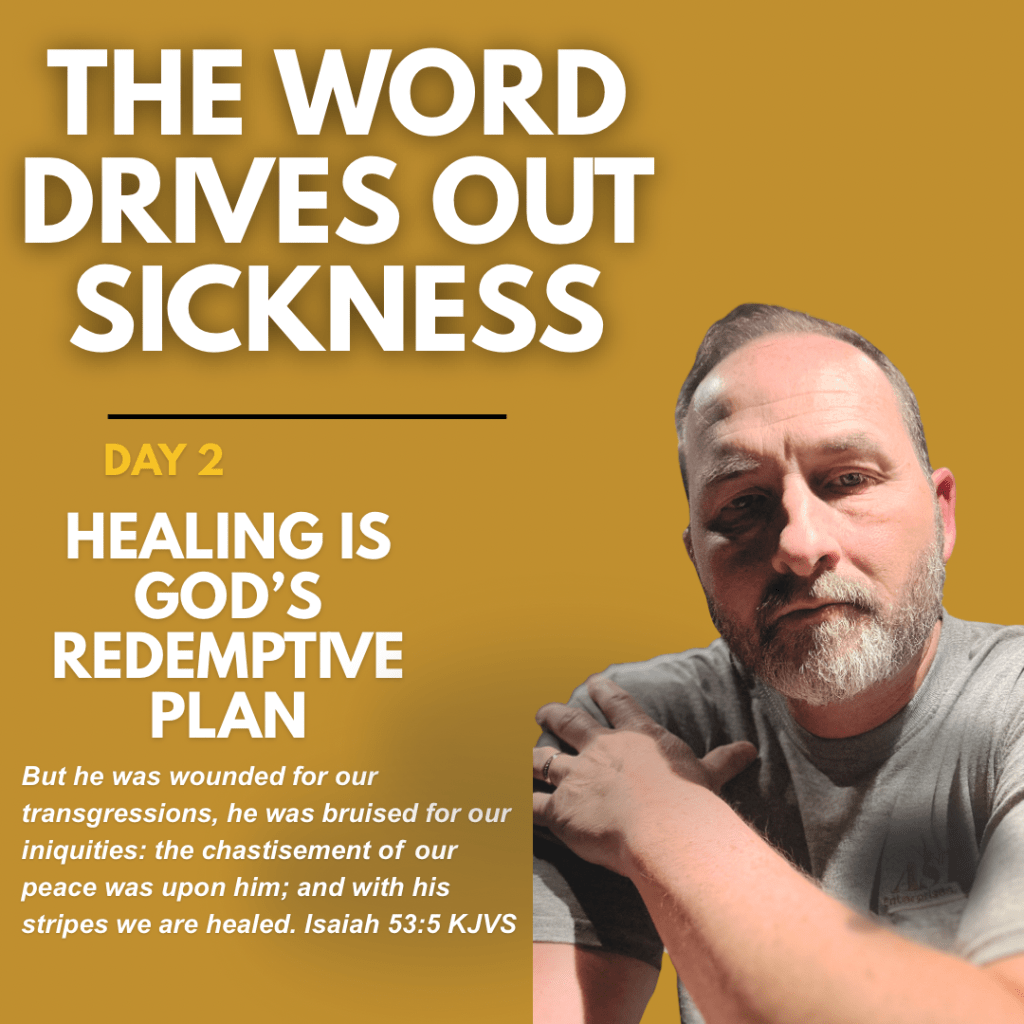
The Word Drives Out Sickness
Key Scriptures: Isaiah 53:4–5, Matthew 8:17, 1 Peter 2:24
Healing is not a separate doctrine. It’s not a bonus or a fringe benefit. It’s not something God might do if He’s in a good mood. Healing is a settled fact in the redemptive work of Jesus Christ. It’s part of the Atonement—just as much as the forgiveness of sins. You can’t separate one from the other without weakening both.
God’s plan of redemption was never partial. It didn’t leave part of man untouched. The blood of Jesus didn’t just cleanse your spirit—it paid for your body too. And until you understand that, you’ll never stand your ground when the devil tries to bring symptoms into your body.
Let’s get this straight: the Atonement includes healing. If you believe Jesus bore your sin, then you have to believe He bore your sickness—because the Word says so.
Isaiah 53:4–5 says:
“Surely he hath borne our griefs, and carried our sorrows: yet we did esteem him stricken, smitten of God, and afflicted. But he was wounded for our transgressions, he was bruised for our iniquities: the chastisement of our peace was upon him; and with his stripes we are healed.”
You’ll notice that it says He hath borne. Not He will bear. Not He might bear someday. He hath borne. That’s past tense. That means it’s already done. That means the work is complete. And when you look at the original language—when you dig into what Isaiah wrote—you find that the word translated griefs literally means sicknesses, and the word sorrows means pains. You don’t need a theology degree to figure that out. Just read Matthew 8:17 and see what the Holy Spirit says about that passage:
“That it might be fulfilled which was spoken by Esaias the prophet, saying, Himself took our infirmities, and bare our sicknesses.” — Matthew 8:17
That’s what Jesus was doing when He was healing the sick during His earthly ministry—He was fulfilling Isaiah 53. And that was before He went to the Cross. That tells you that healing was already part of His mission from the beginning. But it didn’t stop there. Peter, looking back on the Cross, said it even clearer:
“Who his own self bare our sins in his own body on the tree, that we, being dead to sins, should live unto righteousness: by whose stripes ye were healed.” — 1 Peter 2:24
That’s not a promise. That’s a record. That’s a legal statement of fact. Ye were healed. That’s already happened. That’s your receipt. You don’t need to beg for healing. You need to stand on what already belongs to you.
The Atonement is the legal foundation for your healing. Without it, there’s no guarantee. But because of it, healing is as much your right as salvation. Jesus paid for both at the same time. Sin and sickness were twin burdens laid on Him at Calvary.
You see this truth all throughout the Old Testament types and shadows. The scapegoat in Leviticus 16 didn’t just carry away sin—it carried away the consequences of sin. The high priest didn’t offer blood just for the soul. The blood was applied to cleanse the body, the camp, the nation.
God never redeemed just part of man. When He brought Israel out of Egypt—after the blood of the lamb was applied—they walked out healed. Psalm 105:37 says, “There was not one feeble person among their tribes.” The blood of a natural lamb in a natural covenant was enough to keep them healed through the wilderness. How much more the blood of Jesus?
You’re living under a better covenant, based on better promises (Hebrews 8:6). And if healing was in the old, it sure didn’t get lost in the new. If anything, it was ratified, guaranteed, and sealed in the body of Jesus.
The Church has spent too much time separating what God joined together. When the man let down through the roof was healed in Luke 5, Jesus said, “Your sins are forgiven.” The Pharisees got upset, so Jesus said, “Which is easier to say, ‘Your sins are forgiven,’ or ‘Rise and walk’?” Then He healed the man in front of them to prove the forgiveness.
Why? Because the power that removes sin is the same power that removes sickness. It’s the same grace. The same covenant. The same blood. You can’t preach one and ignore the other.
But what’s happened is this: people will believe God forgave their sins because they don’t have to feel anything to prove it. But when it comes to healing, they start looking for evidence in the body before they’ll believe it. That’s not faith. That’s walking by sight.
Faith believes what the Word says, not what the body says. Faith takes God at His Word and acts like it’s true. If the Word says I’m healed, then I’m healed whether I feel like it or not.
Matthew 8:17 says, “Himself took our infirmities, and bare our sicknesses.” That word “took” is not future tense. It’s not conditional. It’s past tense. It’s complete. He already did it.
I like to say it like this: if He took it, I don’t have it. If He bore it, I don’t. That’s the end of it. The devil has no right to put on you what Jesus already carried away.
You need to settle that in your heart once and for all. The Word doesn’t say you might be healed. It says you were. And if you were, then you are.
Don’t let symptoms talk you out of what belongs to you. Don’t let tradition water it down. Don’t let religion delay what Jesus already delivered.
Stop trying to pay for what’s already been paid for. Your healing is paid in full!
Say it out loud:
Healing is mine. It was paid for at the Cross. Jesus bore my sickness the same time He bore my sin. I’m not waiting to be healed—I already was. I don’t owe the devil anything. I refuse to carry what Jesus already took. I stand on the Word, and the Word says I’m healed. I won’t double-pay. I receive my healing now.
—Joshua L Mullins

 Faith Works
Leave a comment